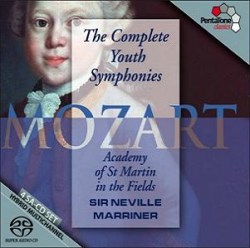
The Complete Youth Symphonies
Wolfgang Amadeus Mozart (1756-1791)
Academy of St Martins in the Field/Neville Marriner
PENTATONE PTC 5186 462
Something gets lost in the telling when we call these works “youth symphonies.” The phrase conjures prodigy mythology — the boy Mozart dashing off masterpieces between carriage rides, his father Leopold hovering with ink-stained fingers — and that mythology, however romantic, tends to flatten what is actually rather complicated musical history. These recordings, made by Neville Marriner and the Academy of St. Martin in the Fields in the 1970s for Philips and originally intended for the then-fashionable quadraphonic format, have had a peculiar afterlife: shelved, reprocessed in Super Audio by PentaTone, released in separate volumes, and now gathered into a single package. The music inside deserves a clearer head than the packaging brings to it.
Start with the title. “Complete” is a word that should give any Mozart scholar pause.
The Symphony no. 1 in e flat, K. 16 — the canonical first, written in London in 1764 when the boy was eight — is nowhere to be found here. Nor are symphonies traditionally numbered 4, 5, 10, 13 through 17, 20, and 21. And at least four of the works that are included may not be Mozart’s at all. The “Neue Lambacher” Symphony in g is almost certainly by Leopold, as the liner notes candidly acknowledge. This is not pedantry. When the question is how many symphonies Mozart actually wrote, the honest answer is: more than 41, probably something in the neighborhood of 56, but with enough asterisks to fill a graduate seminar. Symphonies no. 2 and no. 3 are spurious. No. 37 in g is Michael Haydn’s — his own no. 25 — with Mozart responsible only for the slow introduction. No. 11 remains doubtful. The Köchel catalogue, indispensable as it is, becomes genuinely unwieldy in this repertoire, complicated further by the 1960s revision that left scholars juggling two K numbers for a great many works.
None of which, finally, is Marriner’s problem to solve.
What he brings to these pieces — and brought, in his prime, which is roughly when these sessions took place — is exactly what they need: clean phrasing, unforced momentum, strings with a lean, slightly astringent edge that keeps the textures from going soft. The Academy in those years played with a kind of focused brightness that has perhaps mellowed since. You can hear it in the quick movements especially, where Marriner never lets the music lounge. There is a snap to the rhythm, a sense that these short pieces have somewhere to go and intend to get there.
But let’s be honest about what the music is. Written between Mozart’s tenth and nineteenth years, these symphonies are the work of an extraordinarily gifted craftsman absorbing everything around him — the Italianate galant style, the light Viennese manner, a little of the Sturm und Drang that was beginning to stir in the air. They are often charming. Occasionally they surprise. And they are almost entirely indistinguishable, in ambition if not always in finish, from the early symphonies of Paul Wranitzky or Joseph Kraus, composers nobody programs anymore. This is Mozart before Mozart — before the dark undertow of the Piano Concerto in d minor, K. 466, before the counterpoint of the last symphonies, before the uncanny emotional latitude of Così fan tutte. The genius is present, you might say, but it is biding its time.
Competing versions exist — Christopher Hogwood’s period-instrument traversal on L’Oiseau-Lyre has sharper scholarly credentials and a more historically grounded sound — but Marriner’s approach has its own logic. He treats these works as living repertoire rather than musicological curiosities, and the results feel inhabited rather than excavated. That matters. Early music scholarship has given us authenticity at the occasional cost of pleasure.
Marriner, now in his late eighties and Life President of the Academy he built into one of the world’s finest chamber orchestras, still conducts occasionally. These recordings catch him at something close to his best. The ensemble plays as if it believes in every bar, which is more than the works themselves sometimes justify.
Worth having, especially for the convenience of the single-package format. Just don’t take the title literally.