String Quartets – volume 3
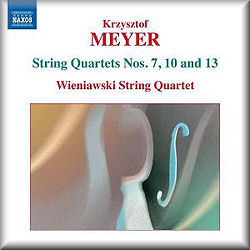
Krzysztof Meyer (b.1943)
Wieniawski String Quartet (Jaroslaw Zolnierczyk (violin I); Miroslaw Bocek (violin II); Lech Balaban (viola); Maciej Mazurek (cello))
NAXOS 8.573001 (77:48)
Krzysztof Meyer has spent decades being overshadowed by his teacher and his obsession. The teacher is Penderecki; the obsession, Shostakovich — whose unfinished opera The Gambler Meyer completed, and whose shadow falls across virtually everything Meyer has written for strings. That’s not entirely a liability. Shostakovich’s example taught Meyer how to compress enormous emotional weight into small gestures, how to make irony and grief coexist in a single phrase, how a passage that seems to be going somewhere comforting can suddenly bare its teeth.
This is the third volume in the Wieniawski Quartet’s systematic traversal of Meyer’s complete string quartets for Naxos. Thirteen quartets so far, a body of work that deserves far more attention than it gets outside Poland.
The Seventh quartet, op. 65, is the shortest piece here — barely a quarter-hour — and the one that makes the easiest impression. Written as a single continuous movement, it has a quality the others don’t quite share: something almost relaxed. Not cheerful, exactly, but breathing without apparent effort. The Wieniawski players bring a clean, unforced tone to it, Jarosław Żołnierczyk leading with a first-violin line that knows when to insist and when to recede. The ensemble never pushes.
The Thirteenth quartet, op. 113, is also cast as a single movement, and it is — if I’m reading the trajectory of Meyer’s career correctly — a kind of earned simplicity. Meyer completed it after the massive, nine-movement “Twelfth”, which appeared on the previous volume. Coming down from that mountain, he seems to have wanted to speak more directly. The Thirteenth isn’t spare, exactly, but it breathes with a certain openness rare in this composer’s work, an openness that feels chosen rather than conceded. This appears to be its first recording, and the Wieniawski players treat it accordingly — with a slight extra alertness, the kind you hear when musicians are still feeling the shape of something new.
But the Tenth quartet, op. 82, is what you come to this disc for. Forty minutes. Four movements, possibly five — I lose track in the best way, because Meyer builds transitions that make movement boundaries feel like questions rather than answers. Written in 1994, it belongs to a period when Meyer had largely put aside the avant-garde techniques he’d explored in his early career, not in surrender but in something closer to self-knowledge. The modernism here is moderate, the harmonic language rooted enough that you can feel the tensions in it — feel them physically, in the way dissonance creates actual muscular bracing in an attentive listener. There’s a slow movement that could have been written by Weinberg — Meyer’s compatriot, another Shostakovich satellite, another composer criminally underplayed in Western concert halls — and I mean that as the highest compliment. The grief in it is specific. Not generalized eastern European melancholy, which can become a kind of wallpaper, but something that feels located, remembered, personal.
Bartók is in the room too, particularly in the quartet’s more aggressive passages — the abrupt rhythmic displacements, the percussive use of the bow, moments where the viola suddenly matters more than anything else in the texture. Lech Balaban handles those moments with authority.
The earlier Wilanów Quartet recordings of the first twelve quartets — initially issued in the 1990s on Pro Viva, not easy to find now — remain a legitimate reference point. But the Wieniawski ensemble brings its own virtues: a somewhat warmer collective sound, slightly less astringent, which suits the Tenth particularly well. Whether that warmth costs anything in the more angular passages is a fair question. I think it costs a little. The music occasionally wants more edge than it gets here.
No matter. This is a serious, committed album of music that rewards serious, committed listening. Meyer is not Shostakovich. He’s not Bartók. He’s not even quite Penderecki, whose Third Quartet Meyer had already lapped by the time Penderecki got around to writing it. What he is — finally, stubbornly, on his own terms — is himself.