Gustav MAHLER (1860-1911) Symphony No. 9 in D minor (1908-1909)
Gustav Mahler (1860-1911)
Los Angeles Philharmonic/Gustavo Dudamel
DEUTSCHE GRAMMOPHON 479 0924 (86:02)
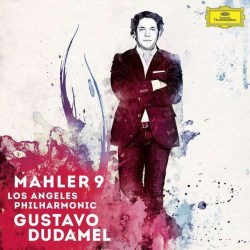
Mahler wrote his Ninth Symphony knowing, on some level, that he would never hear it performed. He had survived a rheumatic fever that damaged his heart; he had lost his daughter Maria to scarlet fever and diphtheria; Alma had taken a lover. The music carries all of that — not as program, but as atmosphere, as something felt in the blood and bone of every phrase. Which is precisely why conductors who approach it without sufficient weight of experience, or without a reckoning with mortality that goes deeper than the podium, tend to produce performances that are technically accomplished and emotionally hollow. Gustavo Dudamel’s account with the Los Angeles Philharmonic, recorded live, falls somewhere in that difficult territory.
Not entirely. Let’s be clear about that.
The opening Andante comodo has moments of genuine loveliness — a transparency in the strings, a lightness of articulation that recalls Klemperer’s late lucidity without approaching that director’s awesome desolation. Dudamel has always had an ear for color and texture, and the Los Angeles Philharmonic plays for him with obvious affection and considerable refinement. But Mahler’s first movement isn’t primarily about beauty. It’s about the struggle to hold onto beauty while it dissolves. That struggle — that terrible, groping quality Bruno Walter caught in his 1938 Vienna recording, the one made just months before the Anschluss made Vienna itself dissolve — is largely absent here. The music glows. It doesn’t ache.
The second movement, the Ländler, is where my reservations harden. Mahler builds this movement out of layered irony: peasant dance music that keeps lurching out of tune, that keeps undercutting its own rusticity with harmonic stabs and rhythmic distortions. It’s Wunderhorn nostalgia curdled. Dudamel takes it at a brisk, attractive pace, and the playing is crisp and often witty — but wit isn’t enough. The movement needs a kind of grotesque weight beneath the dancing, something Bernstein found with the Vienna Philharmonic in his famous 1985 recording, that sense of something sinister turning under the surface. Here the surface remains the surface. The music skates by charmingly and leaves almost no mark.
The Rondo-Burleske — that savage, contrapuntal eruption in the third movement — fares better. Dudamel clearly relishes the violence of it, and the orchestra responds with an energy and precision that’s genuinely exciting. The fugal passages have real bite. For a few minutes one hears what this conductor can do when the music gives him permission to be kinetic, propulsive, almost reckless.
Then the Adagio finale arrives, and the problems return. This is arguably the greatest orchestral valediction in the repertoire — longer and more emotionally complex than the slow movement of Brahms’s Fourth Symphony in e minor, more exposed and more devastating than anything Bruckner attempted. Dudamel shapes it carefully, and there are individual passages of real refinement — the dissolution of the main theme in the closing pages is handled with sensitivity. But the cumulative weight simply isn’t there. The music should make you feel, by the end, that something enormous has passed out of the world. It should leave you sitting in the dark. This performance leaves you admiring the playing.
Among recent recordings, Alan Gilbert’s account with the Stockholm Philharmonic hits harder and digs deeper — there’s an idiomatic urgency to that performance, a sense of genuine reckoning, that holds the ear in ways Dudamel’s never quite manages. And of course the competition in this work is ferocious: Barbirolli’s Berlin Philharmonic release from 1964, Karajan’s two accounts, the extraordinary Giulini with Chicago — the Ninth has attracted conductors at the height of their interpretive powers for decades. Dudamel at his best can be an extraordinary artist. His 2011 Proms Resurrection had that rare quality of feeling genuinely unrepeatable. Whatever produced that electricity was not reliably present in Los Angeles.
This is a rendition worth hearing if you’re building a comparative library of the Ninth, and the recorded sound is superb — detailed, spacious, with fine balance between sections. But as an interpretation it is, finally, insufficient to the music’s demands. The Ninth doesn’t ask to be well-played. It asks to be survived.