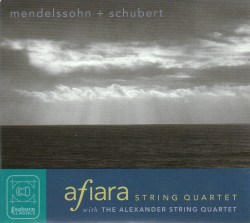
There is something almost vertiginous about confronting the Mendelssohn string quartet in A minor, op. 13 — the work of an eighteen-year-old who had already written the Octet and the Midsummer Night’s Dream Overture, and who now, shaken by Beethoven’s death in March 1827, turned to the late quartets as if to a mirror. The allusions are unmistakable: the searching slow introduction, the way inner voices shoulder melodic weight that Haydn and Mozart would have left to the first violin, the harmonic sidesteps that echo the old master without quite having his iron nerve. Some passages feel so close to Beethoven that you wonder whether the boy was paying homage or simply not yet able to resist the gravitational pull of the greatest music he knew.
The Afiara Quartet plays it with complete seriousness — no condescension, no attempt to sand away the rough edges in favor of easy lyricism. Good. The opening Allegro vivace has a turbulence that is genuinely unsettling, and the Afiaras trust the discomfort. Their intonation is immaculate without being antiseptic; you can hear the players breathing together, adjusting — the slight lean into a phrase, the almost imperceptible hesitation before a harmonic surprise. The slow movement’s fugue is shaped with patience and clarity, its episodes of agitation arriving with real force. And the minuet — which carries within it something folksong-plain, almost Slavic in coloring — is handled with exactly the right gravity. The scherzo-like Trio, all Mendelssohnian elfin shimmer, flickers past and is gone.
What the Afiaras do especially well is sustain tension through slower music without letting it sag. That’s harder than it sounds.
The Schubert Quartettsatz in C minor, D. 703 is one of the most tantalizing fragments in all of chamber music — a single first movement, written in 1820 when Schubert was twenty-three, the projected slow movement abandoned after a few bars. It sits in the same emotional territory as the Unfinished Symphony, composed two years later, and the comparison is not merely chronological: both works open with that characteristic Schubertian tremolo in the lower strings, both set lyrical second themes against a background of barely suppressed dread. The Erlkönig comparison that gets made is apt — the relentless triplet motion, the nervous energy, the way tenderness and terror alternate without resolution.
The Afiaras dispatch it in just under nine minutes — brisk, propulsive, tight as a coiled spring. The momentum never lets up. Whether this is the right approach is a question worth asking; the Emerson Quartet, in their old Deutsche Grammophon disc, found more darkness in the silences between phrases. But there is something to be said for the Afiaras’ directness.
Mendelssohn wrote it at sixteen. Sixteen. Even allowing for the era’s different expectations of prodigies — even remembering that Mozart had written his first symphony at eight — this remains one of the most staggering achievements in the history of music. Eight string players, the forces of a small orchestra, and a teenager from Berlin with apparently no idea that what he was attempting was impossible. The first movement’s opening theme arrives like a gust of warm wind, and the scherzo — marked Mendelssohn’s own favorite among his compositions, reportedly — seems to float free of gravity entirely.
Here the Afiaras are joined by their mentors in the Alexander Quartet, and the result is, to use a word one should probably use sparingly: electrifying. The two ensembles know each other well — the relationship between teacher and student has presumably deepened into something more like musical dialogue, and you can hear it. The eight players move as one organism. The scherzo, in particular, achieves that rare quality of sounding both perfectly controlled and spontaneous, as if the music were being invented in the moment. The finale, with its fugal subject that Mendelssohn later borrowed for the finale of his Italian Symphony, drives to its conclusion with irresistible force.
Is this the recording to own? I’m not sure any single recording of the Octet is definitively that — the I Musici version from the early 1960s has a warmth that may never be equaled, and the Academy of St Martin in the Fields chamber ensemble under Marriner made a strong case in the 1970s. But the Afiara-Alexander collaboration is among the finest recent versions, and the coupling — the A minor quartet and the Schubert fragment — is intelligent and rewarding. These are young musicians who play with the combination of technical command and interpretive conviction that is rarer than it should be.
Strongly recommended.