Gustav MAHLER (1860-1911) Symphony No. 8 in E-flat major (1906)
Gustav Mahler (1860-1911)
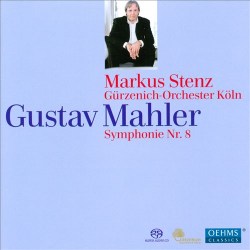
Barbara Haveman, Orla Boylan, Christiane Oelze, Anna Palimina, Petra Lang, Maria Radner, Brandon Jovanovich, Hanno Müller-Brachmann, Günther Groissböck; Mädchen und Knaben der Chöre am Kölner Dom; Chor des Bach-Vereins Köln; Domkantorei Köln; Philharmonischer Chor der Stadt Bonn/Vokalensemble Kölner Dom; Gürzenich-Orchester Köln/Markus Stenz
OEHMS CLASSICS OC 653 (77:01)
Mahler himself conducted the premiere of his Eighth Symphony in Munich in September 1910, before an audience that included Siegfried Wagner, Arthur Schnitzler, and Stefan Zweig — and the event was so overwhelming that even the composer, not a man given to false modesty, seemed stunned by what he had unleashed. That context matters. This is music that was designed to be an event, a collision of the cosmic and the carnal, and any director who approaches it as merely a large piece of music has already lost the argument.
Markus Stenz does not lose the argument. Not entirely, anyway.
His account with the Gürzenich-Orchester Köln, recorded in the Kölner Philharmonie in September 2011, arrives mid-cycle — the Sixth, Seventh, and Ninth are still outstanding — and one might reasonably ask why he tackled the Eighth before finishing what he started. No law against it, of course. Mahler’s own relationship to the symphony’s place in the sequence was complicated; he once described it as standing apart from the numbered series altogether, a gift to humanity rather than a chapter in an ongoing autobiography. Perhaps Stenz felt something similar.
The opening “Veni, creator spiritus” lands with genuine force. Stenz is not Solti — few are — and he doesn’t try to replicate the almost violent energy of that legendary 1971 Decca album, made with the Chicago Symphony in Vienna’s Sofiensaal, where the brass in the opening bars sound like the walls of the world coming apart. Stenz is more measured, more architectural. Which is not a criticism. It is a choice, and for much of Part I it pays off handsomely.
The soloists are well chosen and — this matters more than people admit — intelligently placed in the recorded acoustic so that individual voices register without the blurring that has plagued some otherwise admirable performances. Brandon Jovanovich’s Doctor Marianus is ardent and clear-toned, the tenor line riding the orchestral texture rather than fighting it. Christiane Oelze as Una Poenitentium brings an almost Lieder-like intimacy to her music, which is exactly right — Mahler’s setting of the closing scene of Faust is, among other things, a chamber work for eight voices that happens to require massive forces behind it. Günther Groissböck’s Pater Profundus is suitably weighty, the bass voice anchoring the harmonic foundation of Part II with something close to physical gravity.
The “Accende” passage in Part I — where the music lurches forward with that impetuous, almost reckless energy Mahler notated so precisely — is brought off with real conviction. The hectic passage that follows sustains momentum without collapsing into mere noise, which is harder than it sounds.
What Stenz perhaps underplays is the music’s streak of terrifying vulnerability. The Eighth is not only monumental. Buried inside its gigantism is something exposed and almost desperate — Mahler reaching for transcendence while knowing, on some level, that transcendence cannot be willed into existence. The great pianissimo passages, where the huge forces suddenly contract to near-silence, need to feel genuinely precarious, as if the architecture might not hold. Stenz’s version is too well-managed in those moments. The danger recedes.
The choral forces — the Mädchen und Knaben der Chöre am Kölner Dom, the Chor des Bach-Vereins Köln, the Domkantorei Köln — sing with discipline and evident commitment. Intonation is generally outstanding. What one occasionally misses is the sense of a choir singing beyond its comfort zone, which is paradoxically what the work sometimes demands.
This is a serious, well-prepared, often impressive reading that belongs in the conversation about the work — but not at the head of it.