Jules MASSENET (1842-1912) Thaïs
Jules Massenet (1842-1912)
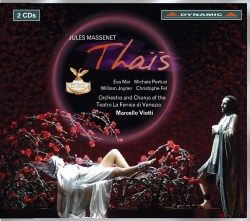
Eva Mei, Michele Pertusi, William Joyner, Christophe Fel, Christine Buffe, Elodie Méchain, Tiziana Carraro, Anna Smiech, Enrico Masiero; Orchestra and Chorus of The Teatro La Fenice, Venice/Marcello Viotti
DYNAMIC CDS 739/1-2 (127.37)
There are operas that suffer from their most famous moments. The “Meditation” from Thaïs — that sinuous violin solo Massenet tucked between the acts like a sigh between arguments — has done its parent work no favors. Violinists from Kreisler to Hilary Hahn have played it in recital halls for a century, and the piece has consequently acquired a reputation for easy sentiment, for perfume-counter religiosity, for the kind of spiritual uplift that asks nothing of you. The opera itself gets tarred with the same brush. Unfair. Deeply unfair.
Massenet was working from Anatole France’s novel, which is not a sentimental book — it’s a cold, rather merciless examination of desire masquerading as devotion, of a man who destroys himself in the act of saving someone else. The monk Athanael converts the courtesan Thaïs to Christianity and loses his own soul in the process. Louis Gallet’s libretto, written in prose rather than the verse conventions French opera normally demanded, keeps that psychological knife edge intact. This predates Maeterlinck’s prose libretto for Debussy’s Pelléas et Mélisande by years, a fact almost nobody mentions. The opera is stranger and harder than its reputation suggests.
Which makes honest, complete performance all the more essential.
This set, drawn from live performances, arrives with considerable vocal talent aboard and considerable liabilities in its luggage. Michele Pertusi brings a genuine bass-baritone weight to Athanael — the voice has that particular darkness in the lower register that the role demands, the sound of a man who has walled himself up inside his own convictions. His Act Two confrontation with Thaïs has real ferocity. William Joyner makes a creditable Nicias, the Epicurean foil to Athanael’s fanaticism, though the part is frankly better than the interpretation. And Eva Mei as Thaïs herself has moments of real beauty — the “Air du miroir” floats with a clean, silvery tone, and she brings more intelligence to the role than the surface glamour of the writing sometimes invites.
But here’s the problem. Or rather, here are several of them.
This recording is not complete. Not even close to complete, actually. A cut of a dozen bars at the close of Act One is the sort of trimming that makes you wonder whether anyone noticed — or cared. More consequential is the omission of the offstage choral writing Massenet later added to the “Meditation.” These aren’t optional extras. Those voices — hushed, hovering at the edges of audibility — lift the music out of the salon and into something genuinely sacred, or at least genuinely strange. Without them, the interlude becomes exactly what its detractors always said it was: pretty mood music. The Renée Fleming recording on Decca included them. So did the old Anna Moffo set on RCA, despite that recording’s other, substantial problems. To leave them out in a recording made decades later is not economy. It’s impoverishment.
And then the ballet. Massenet’s extended dance sequence loses most of its movements here — five of the seven gone, the remainder standing in for a whole architecture of sensuous ambiguity. Conductors and producers have been cutting this opera since the 1950s, when the first sets routinely excised entire scenes. We’ve spent seventy years trying to get a complete Thaïs on disc. This is not it.
The Fleming-Hampson Decca set from 2000 remains the release to own, and at this point that’s not even a close call. Fleming’s voice in that period had exactly the right combination of physical opulence and emotional transparency — she could make you believe simultaneously in Thaïs‘s vanity and her terror, which is precisely what the role asks for. Hampson matched her measure for measure. The conducting was idiomatic, the recording full and present, and — crucially — the score was given with a completeness this new set cannot approach.
Live recordings carry their own electricity, their own sense of risk. This one carries the risk without always delivering the electricity. What we’re left with is a performance that occasionally illuminates a great, undervalued opera and too often simply reminds us how much better we’ve been served before.