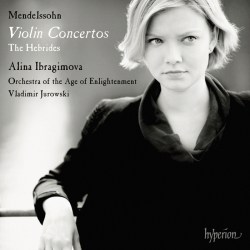
MENDELSSOHN Violin Concerto in E minor, op. 64; The Hebrides; Violin Concerto in D minor (Ibragimova)
Felix Mendelssohn (1809-1847)
Alina Ibragimova (violin), Orchestra of the Age of Enlightenment/Vladimir Jurowski
HYPERION CDA67795 (56:22)
Mendelssohn was thirteen years old when he wrote the Violin Concerto in D minor, and the fact that it sounds nothing like a prodigy showing off is itself astonishing. It sounds like music — purposeful, shapely, already in command of its own emotional weather. That we had to wait until the late twentieth century before anyone thought to record it regularly says something unflattering about the conservatism of the concert world, and something rather wonderful about what we still have to discover.
Alina Ibragimova has earned the right to be taken seriously on her own terms. Her Bach Sonatas and Partitas for Hyperion were among the most searching accounts in years — technically immaculate, yes, but more than that: genuinely inhabited, as if she’d lived inside the counterpoint long enough to make it her own. Her Beethoven sonata cycle from Wigmore Hall belongs in the same conversation as Grumiaux and Szeryng. So this Mendelssohn release arrives with real anticipation.
What she and Vladimir Jurowski have made of it is, finally, a more complicated thing than either admiration or disappointment — though it tilts toward the former by a margin smaller than I’d like.
Start with what is unambiguously right. The Orchestra of the Age of Enlightenment plays with the kind of transparency that modern-instrument ensembles rarely achieve in this repertoire. Gut strings and period winds open up inner voices you simply don’t hear in the standard recordings — there’s a woodwind choir in the slow movement of the E minor concerto in e minor that breathes with a reed-y, slightly reedy vulnerability, almost like a chamber ensemble that wandered in from a Biedermeier drawing room. Jurowski keeps everything scrupulously clean, and the ensemble playing is, on its own terms, flawless.
But here is where things get interesting, and a little uncomfortable. Ibragimova and Jurowski appear to have decided that Mendelssohn is essentially a classicist — that the Romanticism is surface phenomenon, that the pulse must be maintained with something close to severity. The rubato budget on this disc is tiny. Very nearly miserly. The forward momentum is relentless, almost metronomic in places, and while I understand the intellectual argument — Mendelssohn did worship Bach and Mozart, did distrust excess — the music itself seems to be pushing back against the interpretation.
The E minor concerto, op. 64, is not a Classical concerto with a Romantic veneer. It is a work in which the solo violin enters immediately, without orchestral preparation, singing a melody that arrives as if from somewhere both urgent and private — a melody that wants, needs, a little space around it. When Ibragimova finally allows herself that space, around the 2:40 mark of the first movement, introducing the second subject in a hushed pianissimo with the faintest give in the pulse, the effect is genuinely magical. You think: yes, this is what she can do. And then Jurowski’s flutes reassert the forward march, and the moment passes.
Compare Viktoria Mullova’s album, also with a period-instrument ensemble — Mullova finds a fragility in that same second subject that is almost unbearably lovely, a sense that the melody might dissolve if you pressed it too hard. Ibragimova’s version, by contrast, is beautiful but contained, luminous but defended.
The slow movement is where she opens up most fully, and it’s the disc’s finest twenty minutes or so. The inwardness she finds there — tone pulled down to a near-whisper, each phrase shaped with the patience of someone who is actually listening to what comes next — this is playing of real distinction. Mendelssohn was twenty-seven when he sketched the first ideas for this concerto, and he was thirty-eight, the last year of his life, when it was finally performed. There’s a valedictory quality to the slow movement that most violinists miss entirely, treating it as a lyrical interlude rather than the emotional center. Ibragimova does not miss it.
The finale is bracing, even dazzling — Ibragimova’s mastery is beyond question, and the elan of her playing here is infectious. But I kept wanting the lightness to have a little more air in it, a little more of what you might call — for lack of a better word — play. Mendelssohn’s finales are mercurial; they should feel like something that could go either way. This one feels decided in advance.
The D minor concerto is perhaps the disc’s most valuable offering simply because the work is so rarely encountered. Ibragimova and Jurowski make a strong case for it — it is not a masterpiece, but it is not a curiosity either. The slow movement, in particular, shows a boy who already understood what slow movements are for. That is a remarkable thing to understand at any age.
A disc, then, to admire more than to love — which is not nothing, and which, given Ibragimova’s gifts, is genuinely worth having.