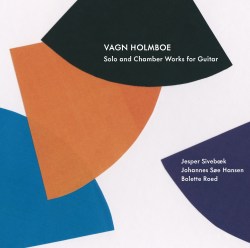
Vagn HOLMBOE (1909-1996) Solo & chamber works for guitar
Vagn Holmboe (1909-1996)
Jesper Siveboek (guitar); Bolette Roed (recorder); Johannes Søe Hansen (violin)
DACAPO 8.226143 (71.20)
Late Holmboe is an acquired taste, and I’ll confess it took me years to acquire it fully. The symphonies and string quartets came first — those massive, organically unfolding structures that earned him the nickname “the Danish Sibelius,” a label he found reductive and probably deserved to. But the guitar music? That arrived when Holmboe was already 70, and it carries the particular quality of a composer teaching himself a new language in his eighth decade, which is either inspiring or slightly awkward depending on the piece.
Both qualities show up here.
The First Sonata is the longest work on the disc, five movements, and you can feel Holmboe finding his footing — sometimes thrillingly, sometimes less so. The central fugato is genuinely accomplished, the kind of contrapuntal thinking that runs like iron through all his best work. But elsewhere the writing thins out into what I can only call note-spinning: those Eastern European modal scales he had been absorbing since his fieldwork in Romania in the late 1930s cycling through without quite arriving anywhere. He studied those scales with the same systematic intensity he brought to everything, and sometimes the guitar works feel like compositional homework rather than fully inhabited music.
Then the Second Sonata arrives, and something clicks.
Written immediately after the first, it is more succinct — more cantabile in its melodic thinking, more classical in its proportions. Holmboe abandons his own tempo markings here in favor of Italian terms, and that small formal decision seems to have freed something in him. The opening Moderato has real poise, and the closing Allegro is spiky and alive in a way that reminds you of the chamber music at its most assured. The sound-world remains peculiar — the guitar never quite submits to Holmboe’s characteristic orchestral density — but the organic logic that distinguishes his finest writing is genuinely present.
The Five Intermezzi, compiled two years after the sonatas, represent something of a pivot. Why not call them a third sonata? Probably because the final movement — the longest — is built around a Spanish lullaby melody, which pulls the piece into a different gravitational field entirely. It’s an unexpected warmth from a composer not especially associated with warmth.
There was a previous LP — Maria Kammerling, 1983, a disc that appeared alongside Holmboe’s extraordinary Eleventh Symphony in his catalog. Kammerling played with real strength and vitality, and I have a lingering affection for her account despite the short measure of that disc. The new interpretation matches her energy and occasionally surpasses her in clarity of line, though something in Kammerling’s attack felt marginally more idiomatic — less considered, more instinctive. That is not a trivial distinction in music this spare.
Still. This is the first complete survey of Holmboe’s guitar output, which matters simply as documentation. And it makes a stronger cumulative case for this music than I would have predicted — the Second Sonata in particular deserves to be heard by anyone who loves the quartets and has wondered where else that late style traveled. It traveled here, imperfectly, interestingly, and sometimes beautifully.