Symphony no. 6 in G major, Le Matin (?1761) [23:20]
Symphony no. 7 in C major, Le Midi (1761) [24:52]
Symphony no. 8 in G major, Le Soir (?1761) [23:38]
La Petite Bande/Sigiswald Kuijken (violin)
rec. Galaxy Studios, Mol, January 2012. DDD
ACCENT ACC 24272 [71:57]
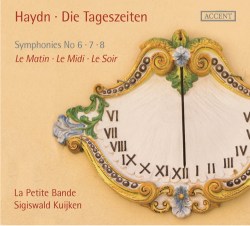 There is a moment near the opening of Le Matin — Symphony No. 6 in D, the first of the three so-called Day Symphonies Haydn composed shortly after arriving at Esterháza in 1761 — where a single flute rises out of silence like the first shaft of light clearing a treeline. Haydn was twenty-nine, newly employed, eager to show his new patron what he could do. What he did was astonishing.These three works, Le Matin, Le Midi, and Le Soir, are not quite like anything else in the symphonic literature. They are symphonies, yes — but also concerto grossi in disguise, also tone poems avant la lettre, also something very close to chamber music inflated just enough to fill a small hall. The solo writing is extraordinary: practically every desk gets a moment, as if the young Kapellmeister were introducing his new colleagues one by one to Prince Nikolaus. There is a cello that steps forward in Le Matin‘s slow movement with the quiet confidence of someone who knows exactly what he’s worth. The flute, the oboe, the bassoon — that bassoon, honking its bird-calls in the first movement like some improbable prehistoric creature — all get their turns.Period-instrument recordings of these works are rarer than you’d think, given how frequently they appear on programs. Most conductors seem to reach for modern strings as a matter of reflex.
Which makes this pair of releases worth paying attention to. The Wrocław Baroque Orchestra, the National Forum of Music’s period ensemble and apparently Poland’s only such orchestra of standing, comes at Le Matin with a freshness that feels entirely unself-conscious — three first violins, three seconds, plus the usual single desks of viola, cello, and bass. That modest string body gives the winds room to breathe, and breathe they do. The opening introduction unfolds with genuine wonder, the crescendo building as if the musicians themselves are just discovering what daylight looks like. When the Allegro arrives, the strings scurry and jostle with the jerky, creature-shaking-itself-awake energy that Haydn wrote into every dotted figure. And then — this stopped me cold the first time through — the recapitulation begins not where you expect it but on a solo horn, a sudden flowering of solitude in the middle of all that bustle. It’s one of those Haydn sleights of hand that sound inevitable only after you’ve heard them. The Wrocław players don’t underline the moment. They simply let it happen. That restraint is itself an interpretation.
La Petite Bande, Sigiswald Kuijken’s Belgian ensemble, takes a different approach. With only two first and two second violins — even leaner than Wrocław — the string articulation becomes something almost percussive, every bow-stroke landing with a precision that borders on the forensic. Dynamic contrasts are etched sharply; the woodwind emerge in relief like figures stepping out of shadow. It is, in the strictest technical sense, a more polished interpretation. The ensemble discipline is remarkable.
But polish is not always the point.
What Haydn built into these works is joy — not the refined pleasures of the drawing room but something more physical, more unguarded. The Wrocław Baroque Orchestra understands this in its bones. There is a cumulative loosening as Le Matin proceeds, the players growing bolder on the repeats, so that by the time that bassoon makes its final bird-call it sounds less like pastoral illustration than like a rude, gleeful thumbing of the nose. Haydn would have loved it.
Anthony Hodgson, writing about these symphonies back in 1976, suggested the Andante of Le Matin depicts a music lesson — the first violin demonstrating its mastery to a cello pupil who quickly proves no one’s pupil at all. The metaphor is charming and not entirely wrong. What it misses is the egalitarianism underneath: Haydn, the new boy at Esterháza, was also writing himself into the music. He too was showing what he could do.
The Wrocław album captures that spirit. La Petite Bande gives you Haydn the craftsman. The Poles give you Haydn the young man — alive, ambitious, delighted with the world before him at dawn.