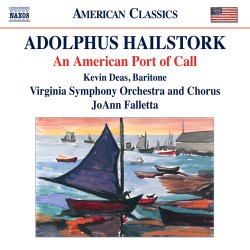
Adolphus HAILSTORK (b.1941) Symphony no.1; Three Spirituals; An American Port of Call; Fanfare on Amazing Grace; Whitman’s Journey I
Adolphus Hailstork (b.1941)
Kevin Deas (baritone), Virginia Symphony Chorus/Robert Shoup, Virginia Symphony Orchestra/JoAnn Falletta
NAXOS AMERICAN CLASSICS 8.559722 (59:08)
There are composers whose obscurity is a genuine mystery, and Adolphus Hailstork is one of them. Not that his music makes extravagant demands — quite the opposite. But accessibility alone has never guaranteed an audience, and Hailstork, now well past eighty, has spent decades producing work of real craft and personality while the spotlight wandered elsewhere.
He studied with Nadia Boulanger, as did half the considerable American composers of the postwar generation — Copland, Carter, Harris, Piston, the roll call goes on — and the lineage shows. What Boulanger gave her best students wasn’t a style but a standard, a severity of structural expectation that could coexist with almost any surface manner. In Hailstork’s case the surface is warm, diatonic, often exuberant, and frankly Coplandesque in ways he has never tried to disguise. That’s not a criticism. Copland’s American vernacular was always meant to be borrowed from.
The First Symphony is the most substantive thing here. Four movements, neo-Classical in architecture, with a rhythmic energy in the outer movements that recalls the Copland of El Salón México and Appalachian Spring — the lean, percussive Copland rather than the expansive one — and a slow movement of genuine lyric weight. There’s a Stravinskian edge to the wind writing, a slight angularity in the phrase endings, that keeps the whole thing from going slack. JoAnn Falletta has been a quiet champion of exactly this repertoire for years, and the Virginia Symphony plays with obvious investment. The ensemble isn’t the Philadelphia Orchestra, and in the symphony’s more demanding passages you can hear the difference — a certain thinness in the upper strings, brass entrances that don’t quite snap together. But Falletta keeps the architecture clear, and clarity is what this music needs above everything else.
An American Port of Call is the piece most likely to send new listeners hunting for more Hailstork. It’s a concert overture inspired by Norfolk, Virginia, where the composer was born — and where this orchestra is based, which gives the interpretation a homecoming quality that’s almost tangible. The scoring is bright and maritime without being cartoonish, the themes genuinely memorable, the whole thing over almost before you’ve settled in. That brevity is a virtue.
The Three Spirituals — “Everytime I Feel the Spirit,” “Kum Ba Yah,” and “Oh Freedom” — are arranged with an affectionate jazzy lift, and they are unambiguously crowd-pleasing. Nothing wrong with that. “Oh Freedom” has a Gershwin-ish swagger that works better in the concert hall than on repeated listening, but “Kum Ba Yah,” stripped of its campfire associations and given a spare, almost hymn-like setting, is quietly affecting.
Kevin Deas anchors the final work — a setting of Whitman, originally conceived as part of a larger piece, now standing alone — with a voice that is large, dark, and not always subtle. The orchestration around him is Hailstork’s most nuanced on the disc, which creates an interesting tension: the restraint of the writing against the full-throated American optimism of the text. Whitman is easy to mock. Hailstork doesn’t mock him.
The disc is short. That’s a real problem, and not just commercially. It leaves the impression of a sampler rather than an argument, which is a shame because Hailstork deserves to be argued for. Falletta and Naxos have done this before — brought overlooked American composers to a wider audience with exactly this kind of carefully chosen program — and the project is worth continuing. But the case for Hailstork’s importance, which some American critics have overstated with a generosity that serves no one, rests not on any single disc but on the cumulative weight of a body of work that deserves far more recorded documentation than it has. This is a good start. Again.