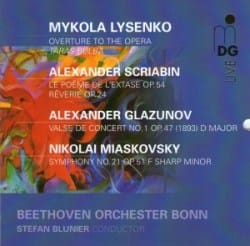
There is a pleasurable obstinacy to a program like this one — music that refuses to be filed neatly, performed by an orchestra most American listeners know primarily by the illustrious name it carries rather than by its actual sound.
Stefan Blunier leads the Beethoven Orchestra, Bonn through a program that orbits, more or less, the years around 1900, though Miaskovsky’s Symphony No. 21 in f-sharp minor quietly demolishes even that modest organizing principle, having been written in 1940. No matter. The hat still more or less fits the peg.
Begin with Mykola Lysenko — and it’s worth beginning there in spirit as well as sequence, because Lysenko deserves more than the footnote he typically receives in Western concert life. He was a formidable figure: composer, ethnomusicologist, tireless champion of Ukrainian musical identity at a moment when that identity was under sustained political pressure. His refusal to allow Tchaikovsky — an admirer, mind you — to stage the opera Taras Bulba in Moscow came down to a single, unbending condition: it would have been sung in Russian. Lysenko said no. That’s not eccentricity. That’s conviction.
The overture itself is vivid, propulsive, and — one should say it plainly — considerably indebted to the very Tchaikovsky Lysenko kept at arm’s length. The irony is rich. Blunier drives it hard, and the playing has genuine momentum.
Then Scriabin. And here things get complicated.
La Poème de l’Extase is music that demands to be lived in, not managed. Scriabin conceived it over roughly two years, completing it in 1907, and the score is less a symphonic poem in any conventional sense than a sustained act of metaphysical theater — the soul ascending, trembling, finally exploding into what Scriabin himself described as the bliss of free activity. The trumpet solos need to feel like revelation. The string writing should shimmer with something close to physical heat. Blunier’s reading is brisk and competent and, unfortunately, largely earthbound. The tempo is decisive without being illuminating, and the orchestra, playing cleanly, never quite ignites. Compare this to Nikolai Golovanov’s extraordinary 1952 album — still the benchmark for many of us — and the distance becomes stark. Golovanov understood that this music lives in its extremities: the hushed passages must be genuinely hushed, almost conspiratorial, so that the climaxes arrive like a blow. Blunier’s dynamic range is narrower, his rubato cautious. The blood, frankly, does not race.
The little Rêverie, op. 24 — one of Scriabin’s earlier orchestral miniatures, still wearing its late-Romantic manners quite comfortably — comes off better. It’s a forgiving piece, and Blunier treats it with a gentleness that suits.
Glazunov’s Valse de concert no. 1 in D major, op. 47 is where the absence of genuine metrical pliability becomes genuinely costly. A waltz — especially Glazunov’s kind of waltz, which carries the perfume of the ballroom but also a certain aristocratic wit — lives or dies by its flexibility, by the slight give and take in the beat that makes the music breathe and sway rather than merely proceed. Anatole Fistoulari, in his 1950s recording, understood this instinctively; his rubato was architectural, each inflection growing logically from the last, so that the music felt both spontaneous and inevitable. Blunier’s version is attractive in outline. But it sits on the page rather than rising from it.
The Miaskovsky symphony is the disc’s most substantial claim on attention. Nikolai Miaskovsky is one of those composers who was enormously influential in his own time and place — he taught virtually everyone, shaped Soviet musical life for decades — and has since retreated into an honorable obscurity that his best work doesn’t quite deserve. The Symphony No. 21 in f-sharp minor, op. 51, written in 1940, is a single-movement work of concentrated emotional force, the kind of piece that suggests a long argument compressed into one decisive statement. Nathan Rakhlin gave the premiere; Ormandy brought it to Western ears on disc. Morton Gould recorded it. The work once had a real life in the repertory.
Blunier’s account is genuinely respectable here — more focused than elsewhere on the program, the orchestra finding a darker, more concentrated tone. The music’s autumnal quality comes through. One wishes for slightly more weight in the lower strings at the principal climax, and the transition back to the opening material could use a touch more mystery — it arrives a bit squarely. But this is the reading on the disc most worth returning to.
A program assembled with evident good intentions, then, performed with solid musicianship and intermittent insight. For the Lysenko alone it earns a place on the shelf. For the Scriabin and Glazunov, keep looking.