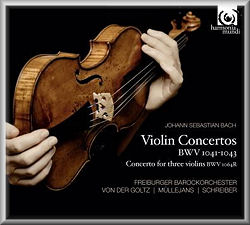
Bach wrote these concertos in Cöthen, most likely, during the years he served Prince Leopold — a prince who actually played the viola da gamba and knew what good music was. That context matters. These weren’t occasional pieces tossed off for a visiting dignitary. They were the product of a composer fully engaged with the Italian concerto style he’d absorbed from Vivaldi, Torelli, and the rest, and determined to outdo them on their own terms. He largely succeeded. The A minor concerto alone, with its inexorable opening ritornello grinding forward like something inevitable, is worth a whole evening’s attention.
What Gottfried von der Goltz and the Freiburger Barockorchester bring to this music is something rarer than virtuosity: proportion. The balance between soloists and ensemble — and here the soloists are also the directors, which changes everything about how the give-and-take actually works — never feels negotiated in advance and then executed. It feels discovered in the moment, phrase by phrase.
The Double Concerto in d minor opens the disc, and the tutti is warm without being upholstered, transparent without that lean, slightly anemic quality that afflicts some period-instrument ensembles when they’re trying too hard to be historically correct. When the two soloists emerge from the texture, they do so as first among equals — not as visiting celebrities stepping out front while the orchestra politely recedes. This matters enormously in the Largo. The movement has been sentimentalized to death by some conductors, turned into something almost Romantic in its yearning. Here it unfolds at a pace that feels organic rather than chosen — like water finding its own level. There’s no rushing, no self-conscious lingering. Just the music, breathing.
Von der Goltz’s E major concerto is a particular pleasure. The first movement bounces — that’s really the only word — with a kind of athletic joy that never tips into the merely athletic. Each phrase in the finale seems to grow from the one before it, the music lifting itself to successively higher planes of energy without any of the effortfulness that can make even distinguished period-instrument playing feel like work. Petra Müllejans brings comparable intelligence to the A minor, pacing the Andante with a patient intelligence that lets the inner voices speak. In lesser hands, that movement can feel like marking time between the outer movements. Not here.
Anna Katharina Schreiber joins von der Goltz and Müllejans for the Concerto for three violins in D — a reconstruction, note that, based on the Triple Keyboard Concerto in d minor, BWV 1063. Bach may or may not have made this version himself; the scholarly consensus wobbles. But the music works superbly in this guise, the three voices weaving around each other with a contrapuntal ease that Bach made look effortless and that is, in fact, fiendishly difficult to bring off.
The competition is formidable and worth acknowledging. Grumiaux’s old Philips recordings retain their aristocratic poise. Standage and the Academy of Ancient Music made a strong case in the 1980s. Hilary Hahn, working with modern instruments, reminds us that there’s more than one way to inhabit these scores. But this Freiburg set stands alongside the best of them — and surpasses some. The recorded sound, close and natural without being airless, is itself a major achievement.
Indispensable? For Bach lovers — yes.