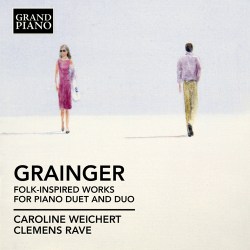
 Percy GRAINGER (1882-1961)
Handel in the Strand, Clog Dance [4:38]
Molly on the Shore, an Irish Reel [4:45]
Shepherd’s Hey [2:23]
Harvest Hymn [2:23]
Country Gardens [2:26]
Song from the Faroe Islands, Let’s Dance Gay in Green Meadow [2:31]
Spoon River [4:25]
As Sally Sat A-Weeping [1:07]
Lincolnshire Posy [17:01]
Fantasy on George Gershwin’s Porgy and Bess [20:57]
Caroline Weichert and Clemens Rave (piano four-hands: Harvest Hymn, Country Gardens, Faroe Song), (two pianos: other tracks)
rec. 6-7 January 2011 (all but Gershwin fantasy) and 11 January 2012, Pianohaus Micke, Münster, Germany
GRAND PIANO GP633 [62:30]
Percy Grainger spent his life refusing to be taken seriously in exactly the ways serious people wanted. He invented his own English vocabulary for musical directions — “louden lots,” “slow off,” “lumpy” — composed for instruments no one else would touch, and dressed in homespun tunics while corresponding with Edvard Grieg as an equal. The classical establishment never quite knew what to do with him, and perhaps that’s why his music sounds so freshly odd even now, a century after most of it was written.
The Bilder Duo — Caroline Weichert and Clemens Rave — have been playing together since 2007, and their rapport shows. Not merely in the technical sense, though they are technically impeccable here, but in something harder to describe: the way they breathe together, the way a phrase tossed from one piano lands in the other’s hands without any audible seam. That kind of ensemble is earned.
Their program draws on Grainger’s own arrangements for piano four-hands and two pianos — a format Grainger returned to obsessively, partly because he loved the medium and partly because he was constitutionally incapable of leaving any piece alone. “Shepherd’s Hey,” “Country Gardens,” Lincolnshire Posy — these are the famous titles, the ones that made him rich and, he sometimes seemed to feel, slightly embarrassed. He was more than a tune-monger. Much more.
Lincolnshire Posy is the proof. The original version here is not the wind band setting that most listeners know — Grainger fashioned this two-piano arrangement almost immediately after completing the band score, as if he couldn’t help himself — and hearing it in this form reveals something the band version can obscure: the harmonic strangeness at the edges of pieces like “Rufford Park Poachers” and “The Lost Lady Found,” the moments where the folk melody brushes against something almost modal, almost wrong, and the wrongness turns out to be exactly right. The Bilder Duo find that quality without underlining it.
But the centerpiece here, and the disc’s genuine claim on attention, is the Fantasy on Gershwin’s Porgy and Bess — twenty minutes of two-piano writing that belongs in the same conversation as Earl Wild’s single-piano Grand Fantasy and Gershwin’s own Catfish Row suite. Grainger wasn’t retelling the opera’s plot. He was doing something more interesting: rearranging its emotional architecture, saving “Summertime” and “Bess, You Is My Woman Now” for the end so they arrive with the weight of delayed gratification. “It Ain’t Necessarily So” passes its main material between the two keyboards in a kind of call-and-response that exploits the medium more cleverly than almost anything else on the disc — you can hear each pianist grinning at the other across the measure line.
The recorded acoustic is slightly constricted at first, a little close-miked, and for the first few minutes I wondered if the engineers had undersold the room. They hadn’t. The space opens as the music demands it, and by the time the Porgy Fantasy reaches its climaxes, the two pianos fill the soundstage with something close to orchestral weight.
The booklet notes are uneven — dates but not always contexts, listings of “reworkings” without adequate explanation of what was reworked from what. Grainger’s sources deserve better. Still.
This is the anthology two-piano devotees have been waiting for, and for Grainger admirers of any stripe it amounts to essential listening. Get it.