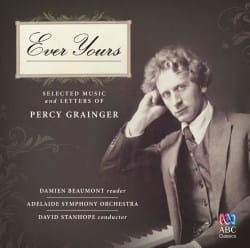
Ever Yours – Selected Music and Letters of Percy Grainger
Percy Grainger (1882-1961)
Damien Beaumont (reader), Adelaide Symphony Orchestra/David Stanhope
ABC CLASSICS 476 4628 (63:28)
Percy Grainger was a man who defied every category his contemporaries tried to press him into, and he spent a lifetime making sure nobody forgot it. Born in Melbourne in 1882, dragged across Europe by an adoring and eventually unraveling mother, shaped by Grieg and Busoni and by his own ferocious will — he was a virtuoso pianist who could outrun most athletes, a composer who heard folk music as living tissue rather than quaint artifact, a theorist who dreamed of “free music” machines decades before anyone else had the vocabulary for it. Getting him whole on a single disc is, frankly, impossible. What this release does instead is something shrewder: it offers Grainger in his own voice, or as close to that voice as any anthology can manage.
The conceit is elegant. Damien Beaumont reads from Grainger’s letters — short, carefully chosen extracts — and the readings alternate with complete musical pieces, all brief, all drawn from the familiar end of the catalog. “Country Gardens” is here. So is “Molly on the Shore.” The program doesn’t attempt the genuinely difficult Grainger, the composer who wrote The Warriors — that astonishing, erupting mess of percussion and multiple simultaneous orchestras that still sounds like nothing else from 1913 — or the later experiments in what he called “free music,” those weird harmonic contraptions he was building in the 1940s with oscillators and paper rolls. The omission is understandable. It would be like introducing someone to James Joyce by starting with Finnegans Wake. But listeners who come away thinking they’ve heard the complete Grainger should know better.
David Stanhope conducts, and he clearly loves this repertoire. The string playing has that particular quality Grainger demands — a slow, tide-like surge of warmth, sentiment without sentimentality, which is actually the hardest balance to find in this music. The jollier pieces have genuine bounce. Nothing here sounds dutiful.
Beaumont reads well. Wide-eyed, the source annotation says, and that’s fair — there’s an openness in his delivery, an absence of actorly self-consciousness, that suits the material perfectly. Grainger’s prose, with its insistence on Anglo-Saxon English — “blue-eyed” for “Nordic,” “tone-art” for “music” — can read as eccentric to the point of crankiness on the page. Spoken aloud by someone who doesn’t wink at it, the idiosyncrasy becomes something else: it sounds like conviction, even ardor. Beaumont has done this kind of narrator-orator work before, in Strauss’s Enoch Arden and in Britten’s setting of the Metamorphoses — he knows how to carry a text without swamping it.
The letters themselves range widely. Grainger on his own compositions: “I undertake [them] largely as a kind of artistic duty.” Grainger on his nature: “To produce clever overrefined sensual wild types like me.” Grainger on a turning point in his life, unnamed but felt. The famous 1932 episode involving his clothing mania — he and his wife Ella embraced an extreme form of toweling garment — is touched on with what I can only call tactful specificity. The sadomasochism, the obsessive documentation of his own life, the museum he built in White Plains to house it all: these are acknowledged. No biography of Grainger can pretend they aren’t there.
Kay Dreyfus provides the liner notes, and that’s a notable name to have on board. Her 1985 edition of the letters, The Farthest North of Humanness — Grainger’s own phrase, naturally — remains the essential document for anyone who wants to follow the man into his stranger territories. She brings real scholarship to the annotation without burying the listener in it.
For comparison: the Chandos Grainger Edition, with various conductors and soloists over multiple volumes, is still the place to go for breadth and recorded quality. Some of those performances — Richard Hickox’s work especially — are genuinely revelatory. This release doesn’t compete with that. It doesn’t try to. What it offers instead is an introduction with unusual integrity: the music and the man together, neither prettified nor sensationalized. For the newcomer, there is no better starting point. For those who already know the Chandos set, the Beaumont readings alone provide something different enough to justify the investment. Grainger, finally, speaking for himself — which is exactly what he always wanted.