
John Adams: Shaker Loops
Shaker Loops began as a failure. That is not merely biographical decoration; you can hear the struggle in the finished piece—the sense of music trying to shake itself free of an earlier, less successful form.
Its ancestor was Wavemaker, a string quartet in which John Adams attempted to combine the repetitive processes of Minimalism with his fascination for waveforms. The premiere went badly. Rather than abandon the material, Adams took it into his composition classes at the San Francisco Conservatory and began dismantling it. He changed the structure, rewrote much of the music, and expanded the quartet into a septet for three violins, viola, two cellos, and double bass. The transformed work appeared in 1978 as Shaker Loops.
The title works in several directions at once. “Loops” refers to the tape loops used by Minimalist composers during the 1960s—Steve Reich’s It’s Gonna Rain is the obvious example. “Shake” suggests the rapid tremolo that drives so much of the string writing. The title also evokes the Shakers themselves and the physical trembling associated with religious ecstasy.
That combination of machinery and ecstasy is central to the piece. Minimalism can sometimes sound as though a process has been switched on and left to run. Shaker Loops never does. Its repetitions accumulate pressure, change direction, collide, and occasionally seem ready to tear the music apart.
The opening section, “Shaking and Trembling,” begins in a state of nervous agitation. Rapid repeated notes pass through the ensemble in waves, creating movement without conventional melody. The effect is physical before it is intellectual. The strings do not merely play patterns; they quiver.
“Hymning Slews” slows the outward activity, but the music never becomes truly still. Long glissandi drift across one another like mist moving through trees. The surface is calmer, yet something continues to stir underneath. Adams was already learning how to make sustained tones feel as active as repeated ones.
“Loops and Verses” brings a more openly lyrical voice into the piece. Here the repetitions begin to resemble accompaniment rather than subject, and fragments of melody emerge from the surrounding motion. The section builds toward what Adams called the work’s “emotional high point,” a wild push-and-pull passage in which lyricism and rhythmic pressure finally become inseparable.
“A Final Shaking” returns to the restlessness of the opening. The music tightens, accelerates, and drives toward its conclusion with an urgency that makes the whole work seem less like a formal experiment than a controlled seizure.
Adams Conducts the Orchestral Version

John Adams: Violin Concerto / Shaker Loops
Orchestra of St. Luke’s; John Adams — Nonesuch 7559-79360-2
In 1983 Adams expanded Shaker Loops for string orchestra. This is the version most listeners know, and it has become one of his most popular scores. It was also used in the film Barfly, where its anxious repetitions fit Charles Bukowski’s disordered world rather better than one might expect.
Adams’s 1988 recording with the Orchestra of St. Luke’s has the obvious authority of a composer conducting his own work. The larger string body gives the music weight and richness without sacrificing too much clarity. The tremolos have real bite, the slow passages breathe, and the climaxes arrive with tremendous cumulative force.
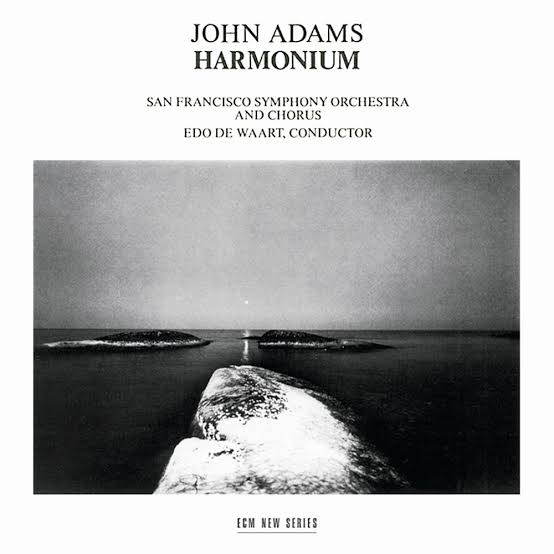
John Adams: Harmonium / Shaker Loops
San Francisco Symphony; Edo de Waart
Edo de Waart’s recording with the San Francisco Symphony is equally persuasive and perhaps even more vibrant. Adams gives us structural control; de Waart gives the piece a slightly more dangerous orchestral brilliance. Either performance makes a strong case for the expanded version.
The Original Septet

John Adams: Chamber Symphony / Shaker Loops / Phrygian Gates
Ensemble Modern; Sian Edwards — RCA 09026 68674-2
Listeners curious about the original septet should hear Sian Edwards and Ensemble Modern. With only seven players, every strand becomes audible. The repetitions are cleaner, the exchanges between instruments sharper, and the entire piece acquires a wiry nervous energy.
The smaller forces inevitably sacrifice some of the orchestral version’s mass and impact, but surprisingly little of its power. In compensation, one hears more clearly how ingeniously Adams distributes his loops and how frequently the musical texture changes beneath the apparent repetition.
The orchestral version overwhelms; the septet exposes. Both are legitimate, and both are worth knowing. But the septet brings us closer to the essential character of Shaker Loops: seven string players caught somewhere between mechanical repetition and religious possession, shaking the same notes until they begin to sound transformed.

