
Carl Friedrich Abel is one of those composers who seems destined to appear in other people’s biographies. He was a friend of the young Mozart, worked alongside Johann Christian Bach in London, and became one of the leading viola da gamba players of his time. His own catalogue was substantial: more than 200 works, including 46 symphonies, 18 string quartets, 16 concertos, and a considerable quantity of music for the viol.
Yet Abel remains largely forgotten. This is especially strange because his music is so immediately attractive. His style is conservative, perhaps partly because he published much of his own work and understood what his audience expected. But conservative does not mean dull. Abel had a genuine lyrical gift, and he understood the value of contrast. Even his symphonies contain turns of phrase and changes of mood that keep the music from settling into polite predictability.
Anyone who enjoys Mozart’s early symphonies should hear him.
The Symphonies

Like many eighteenth-century composers, Abel published his symphonies in sets of six. The complete Op. 7 collection was recorded by Cantilena under Adrian Shepherd in performances that use modern instruments but remain light and restrained (Chandos CHAN 8648).
The sixth symphony from this set has a particularly interesting history. It was long attributed to Mozart and entered the catalogue as his Symphony No. 3, K. 18. It can still be heard under Mozart’s name in Nicholas Ward’s lively recording of the early symphonies with the Northern Chamber Orchestra (Naxos 8.550871–72).
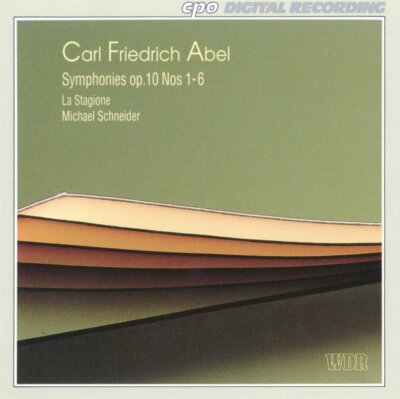

Abel’s Op. 10 symphonies were recorded by La Stagione under Michael Schneider (CPO 999207), while the six symphonies of Op. 17 were taken up by Anthony Halstead and the Hanover Band (CPO 999214). Both collections are worth hearing, and both ensembles play with style. La Stagione benefits from a warmer and more resonant acoustic, however; the Hanover Band sounds comparatively dry.
Chamber Music

Abel’s chamber music reveals an even more personal composer. La Stagione recorded an excellent mixed program containing two flute sonatas from Op. 6, two trios for flutes and continuo, seven pieces for viola da gamba, and a cello sonata (CPO 999209). Once difficult to find, the recording is now available again through downloads and streaming and remains one of the best introductions to Abel beyond the symphonies.
Masahiro Arita included the Flute Sonata, Op. 6, No. 5, in a collection devoted to music by Bach’s pupils (Denon 75025). London Baroque recorded the Quartet, Op. 9, No. 1 (Amon Ra 14), and the Salomon Quartet included Op. 8, No. 5, in an intelligently chosen program of eighteenth-century English quartets (Hyperion CDA66780).
A much stranger proposition comes from Roy Whelden and American Baroque (New Albion 59). The disc combines Abel’s chamber and solo viol music with works by Whelden, sometimes mixing the two composers within the same piece. The playing is good, but the concept is peculiar. With careful programming, it is possible to isolate one complete Abel quartet for flute, violin, viol, and continuo, along with two pieces for solo viol. The remainder belongs to Whelden.
Music for Viola da Gamba

The viola da gamba was Abel’s own instrument, and his music for it deserves particular attention. Petr Hejný recorded six solo sonatas in finely detailed performances that reveal how intricate and demanding Abel’s writing could be. This is not merely agreeable music written to flatter a virtuoso. It has substance, imagination, and an instrumental character unmistakably its own.
A suite of pieces in D minor has appeared several times on disc. Laura Jeppesen offers the most extensive selection, playing five pieces in a program that also includes unfamiliar viol music by Sieur de Machy and Christoph Schaffrath, along with a transcription of Mozart’s Sonata for Bassoon and Cello (Titanic 183). Wieland Kuijken also performs five pieces, although his selection differs by one item (Denon 75659). Paolo Pandolfo chooses only three on A Solo and plays them with characteristic freedom and imagination (Glossa GCD 920403).

The comprehensive Abel recital once conspicuously absent from the catalogue finally arrived in 2008, when Paolo Pandolfo recorded the 29 pieces preserved in the Drexel Manuscript. It is the recording Abel’s admirers had been waiting for. Pandolfo treats these pieces not as antiquarian fragments but as the private working music of a great improvising virtuoso—restless, intimate, technically formidable, and often startlingly free. Together with Hejný’s six sonatas, The Drexel Manuscript establishes beyond reasonable doubt that Abel was not merely Johann Christian Bach’s colleague or the accidental composer of a “Mozart” symphony. He possessed an individual voice, and nowhere is it heard more clearly than in the music he wrote for his own instrument.

