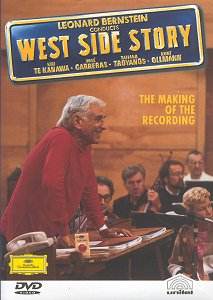
Bernstein: West Side Story
Kiri Te Kanawa, soprano; José Carreras, tenor; Tatiana Troyanos, mezzo-soprano; Kurt Ollmann, baritone; pick-up orchestra; Leonard Bernstein, conductor.
Deutsche Grammophon DVD 073 017–9. Recorded 1984, studio. BBC television film. DVD, 89 minutes.
What we have here is a missed opportunity of almost tragic proportions.
Christopher Swann’s 1984 BBC film of Bernstein recording West Side Story should be—could be—essential viewing. After all, this was the first complete release of the score, uncut by the tyranny of vinyl’s time constraints. Bernstein himself presiding. A cast mixing operatic glamour (Te Kanawa, Carreras) with Broadway savvy (Troyanos, Ollmann). The composer at sixty-six, revisiting what remains his most popular work, nearly three decades after its Broadway premiere. The raw material is there.
But Deutsche Grammophon has issued what amounts to a bare-bones archive dump—the television broadcast, nothing more, transferred with apparent indifference to a format capable of so much more.
The film itself has its moments. Bernstein, alternately avuncular and imperious, coaxes and cajoles. There’s genuine tension when Carreras storms out after a session—temperament or exhaustion, we never learn which. Te Kanawa speaks movingly about the score’s personal meaning, though one wishes someone had pressed her on the technical challenges of singing Maria, a role conceived for a lighter, more vernacular voice than hers. Troyanos mentions her Hell’s Kitchen childhood, the very neighborhood where Tony and Maria’s doomed love plays out, but this tantalizing biographical detail goes unexplored.
The recording process itself—microphone placement, the balance between orchestra and voices, the peculiar compromises of studio work—receives more attention than the music’s dramaturgy. We watch takes and retakes. We see Bernstein shaping phrases, demanding more intensity in “Tonight,” more rhythmic snap in “America.” What we don’t get is context. How was this cast assembled? Why Te Kanawa, whose creamy soprano, however luminous, lacks the raw vulnerability of Carol Lawrence’s original? Why Carreras, whose operatic heft sits uneasily with Tony’s street-kid desperation? The film assumes we already know the show’s genesis, its creative team (Jerome Robbins barely mentioned, Stephen Sondheim not at all), its place in American musical theater history.
And then there’s the technical travesty. DG has issued this PAL-originated BBC production as an NTSC disc—region-free, yes, but at the cost of image quality that looks, as the original reviewer correctly notes, worse than a decent VHS tape. Washed out, lacking detail, the picture does nothing to justify DVD pricing. This matters more than it might seem: Bernstein’s face, his conducting gestures, the physical interaction between performers—these are crucial elements of what is, after all, a visual document. To reproduce them so poorly is to diminish the material itself.
The audio fares better, naturally enough for a DG release documenting a DG recording. The orchestra sounds full-bodied, the voices well captured. But this only emphasizes the disparity between sonic care and visual neglect.
No extras. Not even a timeline of the show’s creation, a gallery of production photographs, or extended interviews culled from what must have been hours of additional footage. Just the 89-minute broadcast, dumped onto disc.
For Bernstein completists or those fascinated by recording studio procedure, this has documentary value. The performances themselves—preserved more faithfully on the audio CD—remain controversial. Te Kanawa brings tonal beauty but questionable dramatic conviction. Carreras sounds effortful. Only Troyanos, with her earthy Anita, seems completely at home in the idiom.
But as a DVD release in 2002, this is lazy work. The material deserved restoration, supplementation, scholarly annotation. Instead we get a film that tells us how Bernstein recorded West Side Story but never quite explains why this particular recording mattered—or whether, in the end, it succeeded in its ambitions.
A document, yes. But not much more.
Gary S. Dalkin