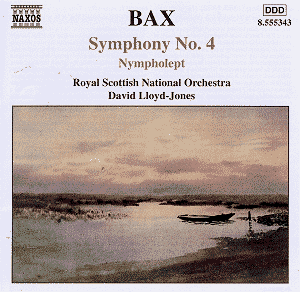
 Bax: Fourth Symphony; Overture to a Picaresque Comedy; Nympholept
David Lloyd-Jones, conductor; Royal Scottish National Orchestra
Chandos. Recorded, Henry Wood Hall, Glasgow. CD.
The Bax symphonic cycle—always a treacherous journey for conductors who mistake luxuriance for indulgence—receives here a performance that understands the composer’s peculiar genius without quite capturing all its fire. Lloyd-Jones, that most reliable of British repertoire specialists, brings to Bax’s Fourth Symphony the sort of patient architectural sense that serves the music’s discursive tendencies well—perhaps too well.
This is a work that sprawls. No getting around it. Written in 1931, when Bax stood midway in his symphonic odyssey—past the Celtic twilight mysticism, not yet arrived at the Sibelian granite of the Fifth and Sixth—the Fourth floats in what one might call a maritime suspension. If Bax had titled it Sea-Phantasy rather than Symphony no. 4, critics would have nodded knowingly and moved on. The music bathes in oceanic light, particularly in that extraordinary Lento moderato where Lloyd-Jones achieves something genuinely haunting: a fade at movement’s end that evokes—I’m reaching here, but stay with me—sun-drenched rock reefs at the uttermost edge of habitation.
The RSNO’s brass section rises magnificently to Bax’s demands. Eight horns! The composer wasn’t being modest, and the peroration to the finale receives here a confident blare, a crest-rolling roar that justifies the orchestral forces. Listen to the way the horns negotiate those Sibelian moments—yes, there are several passages that could have wandered in from Tapiola—with burnished authority. The little harp and flute dance at 7:34 in the finale emerges with rare poignancy, a detail that previous recordings have glossed over.
But—and here’s where scholarly honesty demands candor—Bryden Thomson’s Ulster Orchestra recording on Chandos, coupled rather meanly with just the Second Symphony, possesses a fleet eagerness that Lloyd-Jones’s more expansive approach sacrifices. Thomson drives through the dreamy episodes with forward momentum; Lloyd-Jones tends to bask. The Allegro moderato lives up more to its “moderato” than its “allegro” designation. For music written in 1931, this feels awfully becalmed at times.
The couplings serve Bax’s reputation better. Overture to a Picaresque Comedy struts and serenades with Straussian panache—this is Bax channeling Till Eulenspiegel and Aus Italien, throwing in a wink toward Elgar’s Cockaigne and perhaps Dukas for good measure. Wild, garish colors. Not top-drawer Bax, but gloriously crafted entertainment. Lloyd-Jones handles the whooping slalom run with euphorically pell-mell abandon.
Nympholept proves more problematic. Dedicated to Constant Lambert—whose Pomona takes a cooler, more classical approach to woodland ballet—this 1915 tone poem writhes with forest shadows and dappled summer dazzle. A Swinburnian fantasy with links to George Meredith and the Pre-Raphaelites. The music rustles convincingly enough, but Thomson’s earlier release, despite its overwarm and clouded textures, captured something more seething, more genuinely erotic in its forest-god energies.
The recording quality from Henry Wood Hall in Glasgow catches the RSNO’s characteristic warmth without the textural density that plagued Thomson’s Nympholept. The engineers have done well by Bax’s intricate scoring—those passages where strings divide into multiple desks, where woodwinds weave contrapuntal fantasies beneath brass chorales.
One returns, inevitably, to the question of tempo and architectural vision. Lloyd-Jones treats the Fourth Symphony as a discursive fantasy—which it is—but seems reluctant to push against its tendency toward stasis. The work occupies a peculiar position in Bax’s output: neither the terse tragic epic of the early symphonies nor the gloriously Sibelian fastnesses of the Fifth and Sixth. It has the marine rapture of the Seventh without that work’s valedictory placidity—or is it complacency? Scholars will argue.
The finale, shortest of the three movements, wants more bite. Lloyd-Jones takes things steadily when Bax’s music—particularly in those passages gifted to the brass section—cries out for a touch of savagery. One thinks of Basil Cameron’s sturdy and savage BBC performance of the Northern Ballad no. 1 from the 1950s. That kind of Celtic ferocity.
Still, this remains an essential document in the Bax discography. The Fourth Symphony receives here a performance of considerable beauty and technical accomplishment, even if it lacks the last degree of conviction that would make it a first choice. For newcomers to Bax’s symphonic world, Lloyd-Jones provides a civilized introduction. For devotees—well, we’ll keep Thomson’s recording on the shelf alongside this one, reaching for whichever suits the mood.
A capable, sometimes luminous, occasionally frustrating achievement. Which, come to think of it, describes Bax’s Fourth Symphony rather well.