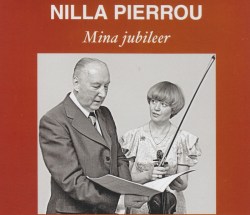
Nilla Pierrou is not a name that appears in the standard encyclopedias of violin playing, and that is the encyclopedia’s loss. This four-disc set from Oak Grove — a second box in what is evidently a sustained act of archival devotion — gathers live broadcasts and studio recordings spanning roughly a decade of work by the Belgian-based Swedish violinist and her long-standing keyboard partner, Eugène De Canck. What emerges is a portrait of a artist with genuine individuality, real interpretive convictions, and the occasional blind spot that tends to accompany both.
The Bach disc opens the set, and opens it well. Pierrou plays the solo concertos with the kind of unhurried authority that invites you to stop multitasking and actually listen. Her tempi are slow — deliberately, almost defiantly so — and she shapes phrases with a suppleness that owes more to the singing line than to any period-practice orthodoxy. This is Bach from inside the emotional argument, not from outside the historical frame. The Sonata for violin and keyboard, recorded in 1984 with De Canck, extends that approach: you feel the two players breathing together, neither one pulling against the other. More remarkable is the Partita in d minor from 1976, specifically the Chaconne — eight years earlier, the playing already shaped by that same attention to dynamic nuance, the architecture built from below, with real pianissimo as structural material rather than mere color. It’s measured but never inert.
Things grow more complicated on the second disc.
The Brahms Sonata in A major — Brussels, 1984, live — is the sort of performance that is technically defensible and yet somehow unsatisfying. Slow tempi alone don’t explain it; Grumiaux played Brahms slowly, and Goldberg slower still, and both understood that Brahms’s slower movements require weight, not just breadth. What’s missing here is bite. The accents arrive softened, the rhythmic spine loosened past the point where flexibility shades into indecision. Three movements go by and I find myself unable to identify a single phrase where the playing insists. The Beethoven Sonata in G major — from the same Brussels sessions — suffers comparably: a sensitively voiced rendition in its middle reaches, but a finale that simply stops moving. Aaron Rosand, whom the source materials invoke, played with that kind of deliberateness too, but always with the sense that the tempo was chosen, not defaulted to. Here the choice feels less assured.
The center of the second disc holds a real discovery. Albert Huybrechts — Belgian, born 1899, dead at thirty-nine — wrote his violin sonata in 1925, and it sounds like a composer triangulating between Florent Schmitt’s muscular post-Romanticism, Debussian harmonic color, and the long Franckian shadow that fell across virtually every Belgian composer of that era. That description might suggest a confused work. It isn’t. Somehow those influences fuse into something genuinely strange and atmospheric, even briefly mystical, and Pierrou’s performance is stylistically right in ways that suggest she has lived with this music rather than merely learned it. There are other recordings, but I doubt any of them makes a stronger case.
Disc three brings more sonatas and shorter pieces, and here the picture clarifies considerably. Bror Beckman’s violin sonata — Swedish, early twentieth century, lyrical in its ambitions if not always tight in its architecture — gets playing that finds the lyricism without apologizing for the discursiveness. The finale wanders. Beckman probably knew it did. Pierrou doesn’t pretend otherwise but keeps the line alive anyway.
Grieg’s First Sonata in F major — 1865, the composer barely twenty-two — is a different matter entirely. The folkloric energy in that opening movement is essentially an invitation to a violinist, and Pierrou accepts it without hesitation. She plays the fiddling passages with genuine abandon, a looseness at the shoulder that you can almost hear in the tone itself. Both the Beckman and the Grieg were recorded in the Swedish Radio studios in 1980 and released originally on Caprice — and the studio pickup is simply better than the live tapes. The acoustic gives her tone room to breathe, and the ensemble balance with De Canck is more transparent, the inner voices of his part audible in ways the live recordings occasionally obscure. These are the best-sounding tracks in the set and among the most persuasive playing.
The Schubert Duo that apparently closes the set — the source materials tantalizingly cut off mid-sentence — I cannot fully assess from what’s available to me here. But if the Grieg is any indication of what Pierrou and De Canck accomplish when the album environment serves them, the Schubert ought to be worth the price of the box on its own.
And the box is worth having — not as a complete endorsement of everything in it, but as documentation of a violinist with a genuine musical personality, which is rarer than it should be. The Bach is distinguished. The Huybrechts is revelatory. The Brahms and Beethoven are honest if underpowered. The Grieg is fun in the best sense — unselfconscious, committed, alive. Pierrou deserves to be in the encyclopedia.