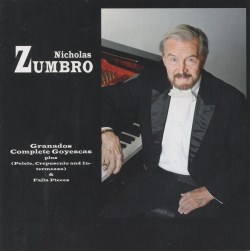
 Enrique GRANADOS (1867-1916)
Goyescas (complete) (1912-16) [65:23]
Manuel de FALLA (1876-1946)
Pantomima [4:16]; Canción del Fuego Fatuo [2:43]
Nicholas Zumbro (piano)
rec. London, 1992.
KRITONOS 8 85767 06331 0 [72:24]
Granados spent years painting without pigment — building the Goyescas from Goya’s tapestry cartoons and his own fevered imagination of 18th-century Madrid, all fans and candlelight and the particular cruelty of desire. The cycle that resulted is among the most demanding things in the Spanish piano repertoire, not technically in the brutal sense of Liszt or Ravel but in a more insidious way: it requires the pianist to sustain poetry across enormous spans, to make decoration feel inevitable, to keep the ornamental and the structural in perpetual, productive tension. Most pianists, even distinguished ones, eventually choose one over the other.
Zumbro doesn’t choose. That’s what distinguishes him.
Tennessee-born, Juilliard-trained, and shaped by a wide European apprenticeship, Zumbro has lived the kind of musical life — teaching at Indiana, Hawaii, Arizona, conducting master-classes on four continents, composing an opera (Kassandra, premiered in Greece in 1990) — that tends to produce either polymaths or dilettantes. He is emphatically the former. And it shows in Goyescas most of all.
What strikes you first is the sound. The Bösendorfer Concert Grand has that characteristic darkness in the bass register — a warmth that a Steinway wouldn’t give you, a resonance that suits Granados’s thick left-hand writing the way a cedar soundboard suits a lute. Engineer Mike Skeet, whose name is too infrequently encountered on disc, has caught it with scrupulous fidelity: the treble sings without glare, the bass breathes without boom. The acoustic is London, the details frustratingly unspecified, but the result is a release that lets the piano simply be a piano.
Now. What Zumbro does with it.
There’s a moment in “Fandango de candil” — roughly midway through, when the main theme returns with added weight — where lesser pianists simply get louder. Zumbro gets larger. The distinction matters enormously. The sound expands from within, the way a great singer’s voice expands on a climactic phrase without any visible effort, and the heroic quality that Granados embedded in the movement’s architecture suddenly becomes audible as something earned rather than applied. Majesty is not a dynamic marking. Zumbro understands that.
“El amor y la muerte” is another matter altogether — introspective, grief-soaked, the most interior of the set’s great movements. Here the dynamic shading is extraordinarily fine, almost cellular: Zumbro will shade a single melodic note within a phrase, tipping its weight slightly, as though the music were being thought rather than played. Tender is not a strong enough word, though it’s the right one.
The complete Goyescas includes “El Pelele” — the straw man tossed on a blanket by laughing women, the one purely extrovert piece in the cycle — and Zumbro dispatches it with explosive, full-bodied virtuosity that reminds you he has this mastery entirely in reserve. It never feels like showing off. It feels like release.
The de Falla pieces that close the program — drawn from El Amor Brujo, that incandescent score of 1915 — are briefer but not negligible. The “Pantomima” in particular brings out something in Zumbro’s playing that the Granados had only suggested: an ability to float a melody free of its accompaniment, to make the harmonic texture recede so the melodic line seems to hover. De Falla wrote that melody as if it had been half-remembered from a dream. Zumbro plays it that way.
Comparisons are hazardous with Goyescas — the field is not enormous but it’s distinguished. Alicia de Larrocha’s several recordings, especially the earlier ones on Hispavox, carry an irreplaceable authority of birthright; she grew up inside this music in a way no American pianist can fully replicate. Aldo Ciccolini’s 1960s recording for EMI has its advocates. But Zumbro belongs in the conversation, and in certain movements — “Fandango de candil,” “El amor y la muerte” — he surpasses everyone I can call readily to mind.
This is a self-released recording, which means it will reach fewer ears than it deserves. That would be a genuine loss. Whoever you are and wherever you are, find it.