# William Walton
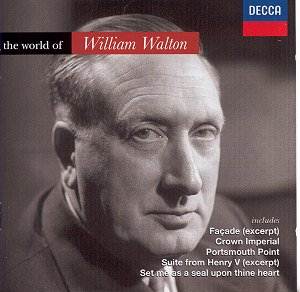
## The World of William Walton
Portsmouth Point Overture; excerpts from Façade, Violin Concerto, Five Bagatelles, Henry V, Symphony No. 2, Belshazzar’s Feast, and other works Peggy Ashcroft, Jeremy Irons (speakers); Tasmin Little (violin); Nicola Hall (guitar); Timothy Moule (treble); William Kendall (tenor); Choir of Winchester Cathedral, London Sinfonietta, Bournemouth Symphony Orchestra, London Philharmonic Band and Chorus, Royal Philharmonic; Orchestra / Sir Adrian Boult, Riccardo Chailly, Andrew Litton, Sir Georg Solti — Vladimir Ashkenazy DECCA 470 127 2 [70:30] — The old Decca “World of…” series returns, repackaged for an era that seems constitutionally incapable of listening to anything complete. Where once these compilations offered whole pieces—modest in scope, perhaps, but intact—we now get movements ripped from their contexts like pages torn from a book.
The "Andante" tranquillo from the Violin Concerto. Two bagatelles from five. A chunk of Belshazzar’s Feast that makes no sense whatsoever without what precedes and follows it.
And yet. I find myself oddly reluctant to dismiss this disc entirely, which probably says — more about the current state of classical music marketing than about my critical faculties. Someone—some curious teenager, some harried commuter, some wedding planner looking for processional music—will encounter Walton here for the first time.
Is that person better served by silence? By nothing at all? The performances themselves range from distinguished to dubious.
Andrew Litton’s Bournemouth traversal anchors the collection, and his “Crown Imperial” positively blazes—those brass fanfares have exactly the ceremonial swagger and underlying warmth that elude so many conductors who mistake pomp for mere noise. The BSO strings dig into the second theme with a richness that recalls the best British orchestral playing of an earlier generation. Litton understands that Walton’s ceremonial music contains genuine feeling beneath the heraldic surface, and — his “Charge and Battle” from Henry V crackles with theatrical energy without descending into bombast.
Tasmin Little brings her characteristic sweetness of tone to the Violin Concerto’s opening movement, though hearing; it severed from what follows feels perverse—like being shown the first act of Hamlet and sent home. The movement’s long-breathed lyricism needs its subsequent transformation in the "scherzo" and "finale" to achieve full meaning. Still, Little’s silvery sound in the upper register and — well — her subtle portamenti (never vulgar, always expressive) remind us why this concerto deserves better than its current neglect.
The Façade selections with Peggy Ashcroft and — well — Jeremy Irons prove more successful, partly because these numbers do function as discrete entities. Ashcroft’s aristocratic diction and Irons’s theatrical flair make a fascinating combination—less cheeky than some interpreters, perhaps, but beautifully articulated. The “Jodelling Song” benefits from their restraint; too many speakers overplay the comedy and — well — kill it stone dead.
Chailly’s London Sinfonietta plays with rhythmic precision and a nice sense of the music’s jazz inflections. But then we encounter the disc’s fatal flaw: that wretched 1954 release of Portsmouth Point under Adrian Boult. The rendition itself has characteristic Boult virtues—clarity of line, rhythmic drive, no fuss—but — the sound is so dim and constricted that the overture’s brilliant orchestration barely registers.
Those spiky woodwind interjections that should leap out? Muffled. The brass snarls?
Emasculated. Starting the compilation with this sonic travesty represents a serious miscalculation. If you’re trying to seduce new listeners, don’t lead with something that sounds like it was recorded in a broom closet.
Solti’s excerpt from Belshazzar’s Feast (“Then sing aloud…”) boasts typical Solti virtues and vices—tremendous excitement, slightly hard-driven choral tone, spectacular engineering. But extracted from context, the number loses much of its power. The oratorio’s dramatic arc depends on accumulation, on the gradual buildup from ominous opening through bacchanalian excess to apocalyptic judgment.
Hearing the final pages of jubilation without having experienced Babylon’s fall and the writing on the wall feels empty, however well sung. Ashkenazy’s "finale" from Symphony No. 2 fares better, since Walton conceived it as a kind of summation—though here too, the movement’s triumphant resolution means less without the preceding struggle.
The RPO plays with conviction, and the recording captures the full weight of Walton’s orchestration, those characteristic major-minor — ambiguities in the harmony, the way the music seems to pull itself up by its bootstraps into affirmation. Nicola Hall’s guitar playing in two of the Five Bagatelles is sensitive and; technically assured, though these miniatures—charming as they are—hardly represent Walton at his most essential. The motet “Set me as a seal upon thine heart” receives a lovely performance from Winchester Cathedral forces, Timothy Moule’s treble gleaming like silver against William Kendall’s warmer tenor and the choir’s rich support.
The subtle intake of breath before the pianist’s attack.
The question remains: for whom is this compilation intended? Serious collectors already own complete recordings of these works in superior performances. Casual listeners presumably want……
well, what do they want? Background music? Greatest hits?
An introduction that might lead somewhere deeper? If the answer is the last—and I hope it is—then this disc succeeds despite itself. Better that someone hears Tasmin Little play one movement of the Violin Concerto and seeks out the rest than never hears it at all.
Better to encounter Walton’s ceremonial magnificence in Litton’s “Crown Imperial” than to remain ignorant of this composer’s particular genius for combining emotional depth with public utterance. But I wish Decca had shown more respect for the music’s integrity. And I wish they’d left off that Portsmouth Point, or at least remastered it properly.
First impressions matter, and this one is needlessly shabby. A compromised enterprise, then, but not without value—assuming listeners treat it as a doorway rather than a destination. Terry Barfoot