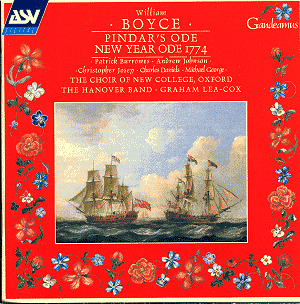
William Boyce
Pindar’s Ode (1741, Dublin version) and New Year Ode (1774)
Hanover Band / Graham Lea-Cox (director)
Patrick Burrowes, Andrew Johnson (boy sopranos)
Christopher Josey (high tenor), Charles Daniels (tenor), Michael George (bass-baritone)
Choir of New College Oxford / Edward Higginbotham (director)
Recorded circa 2001
ASV CD GAU 232 [74:20]
Two things strike immediately on hearing this disc from the Hanover Band: first, the robust energy they bring to Boyce’s occasionally neglected oeuvre; second, the curious, sometimes contentious vocal casting that Graham Lea-Cox has chosen, which—while not without its flaws—furnishes a vivid palette impossible to ignore. This recording follows their earlier triumph with David’s Lamentation over Saul and Jonathan (ASV CD GAU 208), a benchmark in mid-18th-century English choral music, and though Pindar’s Ode and the New Year Ode do not quite reach the same transcendent heights, they are valuable additions to Boyce’s discography and a testament to his often underrated dramatic instinct. Boyce’s Pindar’s Ode, set to Walter Harte’s translation of Pindar’s First Pythian Ode, reveals a composer deeply attuned to the interplay of text and — well — music.
It’s conservative, yes—firmly rooted in the high-Baroque idiom—but richly chromatic in its Dublin revision, where the harmonic language blooms with unexpected color. The orchestra responds with remarkable finesse here: the strings’ incisive attack, the nuanced layering of woodwinds, all contribute a shimmering canvas for the vocal lines. Particularly memorable is Charles Daniels’ arioso “In Fires of Hell,” where the company’s scurrying figures perfectly echo the flickering imagery of flame.
Such word-painting is Boyce at his most vivid—his melodic lines supple, his text setting genuinely sensitive, qualities that have long deserved reappraisal. Yet — the vocal forces present something of a double-edged sword. Lea-Cox’s insistence on period-appropriate timbres leads him to employ boy sopranos Patrick Burrowes and Andrew Johnson alongside a high tenor in Christopher Josey.
There’s undeniable charm in this, a kind of youthful radiance that breathes fresh life into the vocal texture. But it comes at a cost: the boy sopranos’ execution of trills and sustained passages occasionally wobbles under strain, and intonation drifts in moments of heightened difficulty. The high tenor fares better but not without similar vocal challenges.
The result is a vocal ensemble that is, in places, fragile—sometimes too refined when matched against the orchestra’s assured articulation. Fortunately, the mature male voices rescue the vocal dimension where it falters. Charles Daniels’ tenor and Michael George’s bass-baritone stand out.
George in particular, with his solemn delivery of “The Pious Marriner,” brings an affecting gravitas and tonal richness that anchors the work’s more lofty moments. The choir, under Edward Higginbotham’s direction, navigates the final chorus with deft precision, clean diction, and smart dynamic control, bringing the compact but eventful conclusion into sharp relief. Turning to the New Year Ode of 1774, one encounters a piece even more economical and dramatically cohesive.
Its two-movement overture nods toward the emerging “Symphony Style” of the period, with balanced phrasing and a clearer sense of forward motion. Boyce’s craftsmanship here is subtle yet assured—the transitions between recitative and arioso flow almost seamlessly, particularly in “And all that Pomp,” superbly rendered by Michael George. The aria “Say, why do millions bleed at thy command,” voiced by Josey, is a sturdy, if somewhat austere, statement—his softened tone serving the text’s sober sense admirably.
The warm acoustics of the concert hall seem to breathe through the production.
The real highlight of this shorter work comes in the final aria, “Myriads they see,” where Andrew Johnson’s confident boy soprano soars with an almost carefree clarity. It’s a moment of pure, unforced beauty, and the concluding chorus bursts forth with the full, ringing brilliance of the — New College choir—a gratifying culmination that reminds one just how expressive English choral music can be when performed with conviction. In the final tally, this recording is not without its imperfections.
The unevenness in the upper voices sometimes distracts, and there are moments when one wishes for a bit more vocal heft or steadiness. Yet, these are human imperfections—flaws that paradoxically serve to underscore the music’s vitality and the performers’ genuine engagement with a repertoire still waiting to find its broader audience. Boyce’s music here commands renewed respect.
His melodic flair, acute dramatic sense, and text sensitivity emerge clearly. The Hanover Band and — well — Graham Lea-Cox have unearthed treasures that challenge the tidy narratives surrounding English Baroque music’s supposed insularity and lack of invention. This disc is a welcome, if occasionally uneven, ambassador for Boyce’s considerable artistry.
It deserves a place on the shelves of all who seek a fuller, more nuanced picture of eighteenth-century English music beyond the usual suspects—and certainly, it confirms Boyce as a composer truly worthy of our attention.