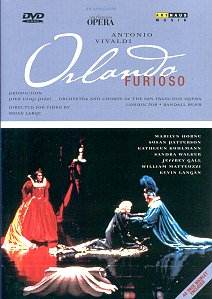
VIVALDI: Orlando Furioso**
Marilyn Horne (Orlando), Susan Patterson (Angelica), Kathleen Kuhlmann (Alcina), Sandra Walker (Bradamante), Jeffrey Gall (Ruggiero), William Matteuzzi (Medoro), Kevin Langan (Astolfo). Ensemble and Chorus of San Francisco Opera/Randall Behr. Production by Pier Luigi Pizzi.
ARTHAUS DVD 100210 [147:00]
Recorded live, San Francisco, 1989
The modern Vivaldi opera revival—and it truly has been a revival, not merely an academic curiosity—began with Pier Luigi Pizzi’s 1979 Verona production of Orlando Furioso. This San Francisco document from a decade later captures what happens when that pioneering vision crosses the Atlantic and encounters American vocal heft. Marilyn Horne’s Orlando is the evening’s gravitational center, though not always its most compelling element.
The voice itself remains formidable—those descents into the chest register still have their old authority, the passagework clean if occasionally cautious. But something’s amiss with her stage deportment. She wanders.
Not aimlessly, exactly, but without the focused intensity that Vivaldi’s furioso demands. Pizzi’s minimal staging—vast empty spaces punctuated by architectural fragments—gives her nowhere to hide, and she seems — at times like a great singer trapped in someone else’s concept of how opera seria should look. The production aesthetic will divide audiences.
Pizzi’s approach is austere to the point of severity: geometric planes, symbolic gestures, costumes that suggest period without specifying it. If you come expecting Baroque exuberance, you’ll be disappointed. But there’s method here—the visual restraint throws the musical architecture into sharp relief, lets you hear the da capo arias as the formal structures they are.
Susan Patterson’s Angelica provides the evening’s vocal peak. Her soprano has that peculiar luminosity that Vivaldi seems to have anticipated—smooth, yes, but with enough edge to cut through the orchestral texture without hardening into shrillness. In “O care selve, o cara libertà” she finds the line between pathos and sentimentality and walks it with uncommon grace.
Jeffrey Gall brings his countertenor to Ruggiero with affecting vulnerability. “Sol da te, mio dolce amore”—that extended meditation with obbligato flute—becomes genuinely moving in his hands, the voice floating above the instrumental line without detaching from it. It’s period-appropriate singing that doesn’t feel like a museum exhibit.
Kathleen Kuhlmann’s Alcina offers both vocal and theatrical rewards. “Vorresti amor da me?” showcases her ability to inflect Vivaldi’s long-breathed phrases with subtle psychological nuance—she makes the sorceress human without softening her menace. And unlike some of her colleagues, she actually inhabits the staging rather than merely enduring it.
The orchestral work under Randall Behr is serviceable without being distinguished. Tempi are sensible, balances generally good, though the continuo section sounds undernourished—perhaps a function of the recording setup. Speaking of which: this is live, with all that entails.
Audience cough drops get a workout, and the singers’ presence varies as they move across the stage. Not ideal, but hardly fatal. William Matteuzzi’s Medoro shows the kind of Italianate tenor sound that Vivaldi would have known—bright, slightly nasal, agile.
Kevin Langan and Sandra Walker complete the cast competently without particularly distinguishing themselves. The libretto, adapted from Ariosto by Grazio Braccioli, is the usual seria business—enchantments, mistaken identities, noble renunciations. It’s hokum, certainly, but Vivaldi’s music transcends its narrative machinery.
Those long arias, with their elaborate ornamentation and instrumental obbligatos, create their own emotional logic. The real question: does this document justify its existence? Given the scarcity of Vivaldi opera on video—even now, more than thirty years later—the answer has to be yes, though with reservations.
You’re not getting a execution that will redefine your understanding of Baroque opera. What you are getting is serious singers grappling seriously with repertoire that was barely known when this was filmed, in a production that at least has intellectual coherence even when it fails theatrically. Horne’s presence alone makes this historically major—one of the great voices of the late twentieth century tackling repertoire she helped bring back from oblivion.
That particular brightness of period instruments catches the ear.
That the overall achievement is mixed rather than triumphant doesn’t diminish the documentary value. And when Patterson or Gall or Kuhlmann catch fire, you remember why people bothered to resurrect these operas in the first place. The video quality is adequate for its era—standard definition, somewhat soft focus, colors that lean toward the pallid.
But you can see what you need to see, hear what you need to hear. The absence of extras is disappointing but not surprising for a release of this vintage. Worth having?
If you care about Vivaldi opera, certainly. If you’re a Horne completist, absolutely. If you want to understand how this repertoire was being approached in the late 1980s, essential.
As a first encounter with Orlando Furioso, though, you might want to look elsewhere—the Spinosi album, perhaps, or one of the more recent stagings. This is a document of historical and musical interest, imperfect but valuable, a snapshot of a revival still finding its footing.