# Villa-Lobos’s Tenth: A Monumental Curiosity from Santa Barbara
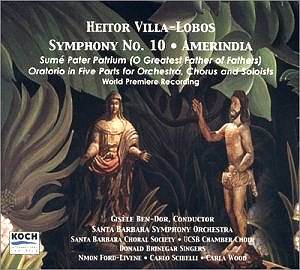
VILLA-LOBOS: Symphony No. 10, “Ameríndia“
Carla Wood (mezzo-soprano), Carlo Scibelli (tenor), Nmon Ford-Livene (bass-baritone); Santa Barbara Choral Society, USCB Chamber Choir, Donald Brinegar Singers; Santa Barbara Symphony Orchestra / Gisèle Ben-Dor
CPO
Here’s a work that time forgot, or perhaps never quite remembered. Villa-Lobos’s Tenth Symphony—also called Sumé Pater Patrum when it wants to emphasize its oratorio credentials—was written for São Paulo’s 400th anniversary in 1954 and premiered in Paris three years later under the composer’s baton. By all accounts, that first reading was the usual Villa-Lobos shambles. But even a polished reading couldn’t have disguised the work’s essential awkwardness: a sprawling choral-orchestral hybrid that must have sounded desperately old-fashioned next to whatever Boulez or Nono was doing that season.
The problem isn’t lack of invention. Villa-Lobos was incapable of writing dull music, and this fifty-two-minute behemoth teems with his characteristic jungle luxuriance—those thick harmonic clusters, the rhythmic vitality that suggests entire percussion sections are about to break loose. The opening movement, “The Earth and its Creatures,” has genuine sweep despite being perhaps ten minutes too long for its material. You hear vintage Villa-Lobos: orchestral colors applied with a trowel rather than a brush, melodic fragments that circle back on themselves like tropical vines.
But symphonic development? That’s another matter entirely.
The second movement, “War Cry,” offers no battle whatsoever—instead, a wistful lament that wouldn’t disturb a siesta. Given that Villa-Lobos (whose claims to indigenous ancestry were almost certainly fabricated) consistently portrayed Portuguese colonization as civilization’s gift to the savages, perhaps we shouldn’t expect historical nuance. The movement does feature the first vocal entries, and when the music finally rouses itself, you catch echoes of the Bachianas Brasileiras—that unmistakable Villa-Lobos blend of Bach and Brazilian folk elements that worked so much better in those earlier scores.
The third movement "scherzo", “Iurupichuna,” takes its title from a species of magical monkey. It’s celebratory, bustling, more successful than what surrounds it. Then comes the massive fourth movement—twenty-four minutes of it—“De Beata Virgine Dei Mater Maria,” essentially a work within a work. Here Villa-Lobos sets Father José de Anchieta’s poem depicting Portuguese arrival, Catholic triumph, Protestant damnation (poor Calvin gets represented as an “Infernal Dragon”). The music functions as a four-part suite, richly textured throughout, but that very richness becomes problematic. When everything is maximalist, where’s the drama? The climactic dragon section should terrify; instead it merely adds more orchestral weight to an already groaning palette.
The "finale", “Glory in Heavens and Peace on Earth,” continues mining Anchieta’s verse with full choral forces. Its affirmation rings hollow to modern ears—all that unquestioning colonial triumphalism—though what else could Villa-Lobos have done? You can’t exactly end this particular piece with ambiguity.
Gisèle Ben-Dor, who has done revelatory work with Latin American repertoire for Koch (her Ginastera and Revueltas recordings are superb), conducts with complete commitment. She understands this music requires energy over refinement, and the Santa Barbara forces respond magnificently. The orchestra—really the stars here—navigates Villa-Lobos’s dense textures with admirable clarity. You can actually hear the inner voices, which isn’t always the case in this composer’s work. The three soloists sing with appropriate vigor if not particular distinction; the massed choruses sound enthusiastic rather than polished, but that’s entirely right for this repertoire.
Ben-Dor’s own liner notes discuss the score’s conducting challenges with refreshing candor. She’s clearly wrestled with this music’s structural peculiarities—the way it can’t quite decide whether it’s symphony, oratorio, or historical pageant.
The recording itself is spacious without being cavernous, capturing the full orchestral spectrum without the choral forces disappearing into the mix. CPO’s ongoing Villa-Lobos symphony cycle (they’re about halfway through numerically) has been consistently well-engineered, and this maintains that standard.
Should you investigate? If you know Villa-Lobos only through the Bachianas Brasileiras, this will surprise you—not always pleasantly. The Tenth lacks the concision and formal elegance of those earlier works. But it’s fascinating in its excesses, its unapologetic maximalism, its sheer Brazilian exuberance. Compared to the subtlety of the choral works on that wonderful Hyperion disc (CDA 66638), this is blunt-force trauma.
Still, for those already committed to Villa-Lobos—and I count myself among that congregation—this disc is essential. Ben-Dor and her Santa Barbara musicians have given this problematic score the best possible advocacy. They can’t solve its structural issues or make its colonial ideology palatable, but they make you understand why Villa-Lobos bothered writing it. That’s no small achievement. A monumental curiosity, then, brilliantly realized—which may be the best one can say about occasional music that outlived its occasion by several decades before it was even premiered.