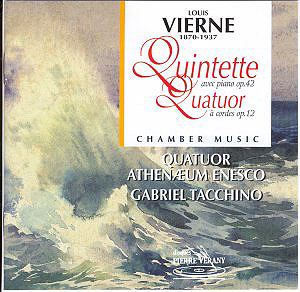
VIERNE: Piano Quintet, Op. 42; String Quartet, Op. 12
Athenaeum Enesco String Quartet; Gabriel Tacchino (piano)
Pierre Verany PV700011 [53:35]
We know Vierne from the organ loft—those six symphonies that rumble through Notre-Dame’s acoustic like emotional seismographs, the Messe Solennelle with its grave splendor. But this? Chamber music that strips away the cathedral’s protective darkness and leaves the composer exposed, vulnerable, speaking in more intimate registers.
The String Quartet dates from 1894, when Vierne was still very much Widor’s creature—assistant at the Conservatoire, deputy at St. Sulpice, absorbing the lessons of cyclic form and architectural balance. You can hear the dutiful student in the genial first movement with its arching lines and syncopated accompaniments, all rather proper. The Intermezzo scurries past in under three minutes. But then—the "Andante", quasi "adagio" catches fire. Here Vierne finds something personal, a brooding introspection that alternates between true "adagio" and more agitated "andante" passages. The Athenaeum Enesco players, Romanians long resident in Paris, understand this duality instinctively. Constantin Bogdanas and Florin Szigeti as the violins maintain a exquisite unanimity of vibrato without sounding cloned; Dan Iarca’s viola adds a burnished middle voice that gives the texture real body.
The "finale" tries to be clever—moto perpetuo interrupted by lyrical episodes, then a rather awkwardly grafted fugue that never quite convinces. Vierne himself later dismissed this quartet as juvenilia, and one understands why. It’s accomplished but not essential, the work of a young man still finding his voice.
The Piano Quintet, Op. 42 is another matter entirely.
Written between 1917 and 1918 after his seventeen-year-old son Jacques was killed in action, this is music carved from grief. Vierne called it a “votive offering” born of “my tenderness and my child’s tragic death.” The first movement opens with piano alone—dark, obsessive, circling around a few chromatic cells like someone unable to leave a graveside. When the strings enter, the restlessness intensifies. But then, on the cello, comes the second subject: a noble, easeful melody that sounds like memory itself, the way we reconstruct those we’ve lost in idealized form.
Gabriel Tacchino understands the piano’s dual role here—sometimes commentator, sometimes protagonist, often simply the voice of inexorable fate. His touch in the opening is almost orchestral in weight, but he can thin it to a whisper when the strings need to breathe. The coda, from around 8:58 onwards, achieves something remarkable: not consolation exactly, but a kind of exhausted acceptance. The Athenaeum Enesco players sustain the long phrases without sentimentality, which is precisely right.
The slow movement begins with Iarca’s viola alone—ruminative, searching. This movement’s predominantly reflective surface keeps cracking open to reveal passionate outbursts, grief that won’t stay contained. After a authoritative climax, tranquility returns, but it feels provisional, temporary.
Then that "finale". Piano chords like hammer blows—a call to arms, yes, but also perhaps the knock at the door that brings terrible news. The main "allegro" drives forward with frightening momentum, suggesting cavalry charges, the machinery of war, all those young men swept up in the moto perpetuo of 1914–1918. At 5:18, Tacchino’s ghostly solo stops time. A few bars of tense, suspended animation. Then the charge resumes and the music hurtles toward its dramatic conclusion.
This is not comfortable listening. Nor should it be.
The release, made at Adyar Hall in Paris in September 1999, captures the players in fairly close perspective. The piano does loom large at climaxes, but I suspect that’s Vierne’s doing—he writes the instrument as orchestral surrogate, and Tacchino plays it that way. The string quartet’s blend is outstanding, though Fodoreanu’s cello could use slightly more prominence in the Quintet’s complex textures.
The liner notes, translated from French with occasional awkwardness, nonetheless provide valuable context. We learn that Vierne’s pupil Bernard Gavoty considered the Quartet “an application of the teachings of Widor“—useful information, even if it damns with faint praise.
Pierre Verany has done French music a service here. The Piano Quintet particularly deserves to be better known—it stands alongside the great war-shadowed chamber works of Ravel and Fauré, though perhaps more rawly emotional than either. The Athenaeum Enesco Quartet and Tacchino make persuasive advocates. Their playing has both technical finish and emotional commitment, never an easy balance in music this exposed.
For anyone who thinks they know Vierne from the organ works alone, this disc offers essential correctives. The man who could command Notre-Dame’s vast spaces could also speak in whispers. And sometimes, as in this Piano Quintet, the whispers cut deeper than the thunder.
Strongly recommended, particularly for the Quintet—a considerable discovery that transcends its relative obscurity through sheer expressive power.