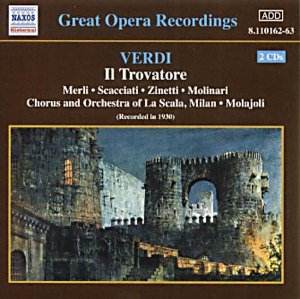
Giuseppe VERDI (1813-1901)
Il Trovatore
Libretto by Salvatore Cammarano
First execution 19 January 1853, Apollo Theatre, Rome
Leonora – Bianca Scacciati (soprano)
Il Conte di Luna – Enrico Molinari (baritone)
Azucena – Giuseppe Zinetti (mezzo-soprano)
Manrico – Francesco Merli (tenor)
Ferrando – Corrado Zambelli (bass)
Ruiz – Emilio Venturini (tenor)
Ines – Ida Mannarini (soprano)
An old gypsy – Enzo Arnaldi (bass)
Chorus and Orchestra of La Scala, Milan
Lorenzo Molajoli (conductor)
Recorded on 28 sides by Italian Columbia, 10-23 September 1930
Appendix: Selected recordings by Bianca Scacciati
NAXOS HISTORICAL 8.110162-63 [150.09]
You can almost hear the rosin dust settling on the strings.
Ward Marston has done it again—coaxed life from shellac that by all rights should sound like someone gargling gravel through a megaphone. This 1930 La Scala Trovatore emerges with astonishing clarity, the voices immediate despite — the band’s slightly recessed placement and that characteristic deadness in the string tone. You hear everything.
Perhaps too much. Start with Corrado Zambelli’s Ferrando, who launches the whole blood-soaked machinery with a narrative so crisply articulated you could diagram every consonant. Those rolled r’s!
Single, double, clipped, extended—a masterclass in Italian diction that makes most contemporary singing sound like mumbling through cotton wool. It’s almost overdone, rather like those frightfully proper British films where everyone says “deddy” instead of “daddy,” but what glorious excess. This is singing that assumes the words matter, that Cammarano’s libretto (convoluted as a Gordian knot, and I won’t attempt to untangle it here) deserves to be understood.
The unanimity of ensemble throughout this performance is remarkable. We’ve grown insufferably smug about our modern standards, assuming that precision is a recent invention requiring click tracks and digital editing. Molajoli and — well — his forces prove otherwise—the coordination between pit and stage, the collective breath of the chorus, the split-second timing in the trickiest florid passages, all impeccable.
The leader, an old hand by 1930, accompanies with consummate skill, never putting a; foot wrong even when Scacciati hurls herself into “Di tale amor” with brilliant, feverish agility. About that soprano. Bianca Scacciati—Toscanini’s favorite, we’re told—possesses a voice of considerable range and dramatic intensity.
The line occasionally fragments where insufficient portamento leaves gaps, but when she floats through the cadenzas of “D’amor sull’ali rosee” in Act IV, effortlessly spinning those beautifully crafted phrases, you understand the Maestro’s admiration. Her illegal top D-flat in the Act I trio thrills even as it technically shouldn’t exist. The final scene of Act IV, that duet with Molinari, finds both singers at their considerable best.
Enrico Molinari brings genuine baritonal heft and theatrical intelligence to the Count. He doesn’t just sing “Il balen del suo sorriso”—he acts it with his voice, shading the phrases to suggest Luna’s conflicted nature. When he trembles (io fremo) at Manrico’s offstage serenade, you actually feel the shudder of jealous rage.
This is Verdian singing of a high order, the kind that reminds us the composer wrote for singing actors, not just refined voices. And then there’s Giuseppe Zinetti’s Azucena. What to make of this?
The chest voice—sometimes approaching what one might charitably call a shout—has that Dame Clara Butt quality, all dark vowels and dramatic color at the expense of textual clarity. “Stride la vampa” becomes more about vocal effect than meaning, though the effect is undeniably compelling. She just manages the ornaments and turns, wrestling the music into submission rather than caressing it.
But perhaps that’s appropriate for a character who has spent decades nursing homicidal vengeance. Francesco Merli’s Manrico brings thrilling top notes and audible effort in roughly equal measure. That high C in “Di quella pira”—conventional and illegal, since Verdi wrote G—rings out for a full six seconds.
Woe betide any tenor who actually sings what the composer wrote, changing nothing from the first verse to the second. The voice has genuine excitement even when you’re aware of the mechanism laboring. The offstage harp in the tower cell strikes me as implausible under the circumstances, but let that pass.
The “Anvil Chorus” receives full-throated treatment, both the singing and — well — the actual anvil-playing tuneful and timely. The “Miserere” that follows boasts surprisingly good intonation from the unaccompanied chorus, though the bell sounds distinctly sharp. The build-up between Scacciati and the offstage Merli generates genuine tension, though one regrets the omission of Leonora’s cabaletta “Tu vedrai; che amore in terra.” Ida Mannarini’s Ines suggests a voice without much shelf-life remaining—there’s a bleat under pressure that doesn’t bode well.
But she manages her brief contributions adequately. The appendix of Scacciati recordings from 1929 and 1931, many featuring Merli as her tenor partner, offers a glorious feast from a golden age. Excerpts from I Lombardi, Marchetti’s Ruy Blas, Gomes’s Il Guarany, and Catalani’s Loreley prove the breadth of her repertoire and the consistency of her artistry.
These are treasures that justify Naxos’s Historical series all by themselves. This is essential listening for anyone interested in Verdi performance practice before World War II, when a certain kind of stylistic freedom—call it license if you’re feeling uncharitable—still held sway. The singing has punch and — well — personality, qualities sometimes sacrificed in our quest for textual purity and vocal beauty.
Marston’s transfer work deserves the highest praise for making this 1930 document so immediately present. A magnificent achievement.