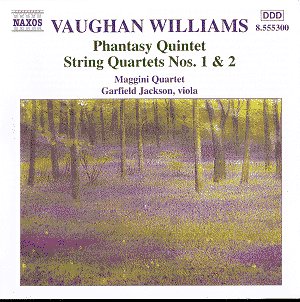
VAUGHAN WILLIAMS: Phantasy Quintet; String Quartets Nos. 1 & 2 Maggini Quartet; Garfield Jackson, viola Naxos 8.555300 [66:29] The Maggini Quartet — has done something rather remarkable here—they’ve made me reconsider music I thought I knew. Not that I’d ever dismissed these works, but hearing them played with this kind — of conviction, this sheer technical address and interpretive intelligence, throws everything into sharper relief.
Start with the String Quartet No. 1 in G minor, written in 1908 and revised thirteen years later after Vaughan Williams had been through the trenches and studied with Ravel. That French connection matters enormously.
You can almost hear the rosin dust settling on the strings.
The harmonic language—cool, astringent, nothing like the supposed cow-pat Englishness his detractors love to mock—owes everything to those lessons in Paris. The opening movement bristles with bold gestures, almost aggressive in their rhythmic precision. The Magginis understand this.
Their attack has real bite, and they command a dynamic range that makes the music’s architecture audible. Whether all these gestures cohere into an entirely unified structure… well, that’s another question.
But when the playing is this good, you stop worrying about formal unity and simply experience the music as a series of beautifully wrought events. The Second Quartet, from 1942-43, is darker territory altogether. Wartime music, inevitably.
The outer movements have a stridency, even violence, that gets properly unleashed here—no genteel English restraint softening the edges. But it’s the central “Romanza” that justifies the entire piece. The Magginis don’t sentimentalize it.
They play it with a kind of restrained ardor, letting the melodic lines unfold with natural breath, and the effect is devastating precisely because they’ve made the surrounding movements so dramatically charged. Context is everything. Garfield Jackson joins for the Phantasy Quintet of 1912, and his presence enriches the sonic palette considerably.
The extra viola voice—not a soloist, despite what the cover design might suggest—allows Vaughan Williams to build those luminous, layered textures that would later suffuse the Fifth Symphony. Jackson blends rather than projects, which is exactly right. The ensemble sound becomes wonderfully varied in color, now burnished and dark, now translucent.
The album itself, made at Potton Hall in June 2000, captures the players in ideal acoustic space—warm but not overly resonant, detailed without being clinical. You can hear the slight rasp of bow hair on string in the more aggressive passages, the breathing of the players in the quieter moments. Are these works masterpieces of the quartet literature?
No, probably not. They lack the inexorable logic of Beethoven’s late quartets, the formal perfection of Bartók. But they’re substantial, serious pieces that reveal unexpected depths when played with this kind of commitment.
The Magginis believe in this music, and their belief is infectious. Naxos continues its remarkable run of intelligent programming and first-rate performances. At super-budget price, this disc is essential for anyone who cares about Vaughan Williams.
For everyone else, it’s a compelling introduction to a composer whose chamber music deserves wider hearing. Only the most determined anti-VWite—and there are a few out there—would find cause for complaint.