A Shropshire Gathering: Vaughan Williams and Gurney in Hyperion’s Thoughtful Pairing
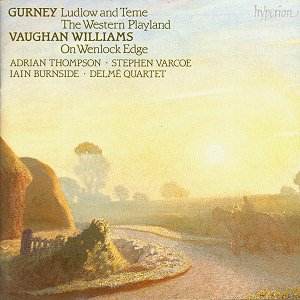
This Hyperion release addresses—though not entirely solves—a persistent gap in the recorded literature: Ivor Gurney’s extraordinary song cycles for voice and piano quintet, those strange, luminous settings of Housman that have lived too long in the shadow of Vaughan Williams’s more celebrated On Wenlock Edge. The pairing makes sense. All three cycles draw from A Shropshire Lad, all employ the unusual sonority of piano with string quartet, and all emerged from that brief, intense period when English composers were trying to shake off German Romanticism without quite knowing what would replace it.
But sense on paper doesn’t always translate to success on disc.
Adrian Thompson tackles Gurney’s Ludlow and Teme (1919–20) with evident intelligence and textual sensitivity. The vocal writing here is treacherous—Gurney sends the line soaring into exposed high registers with a frequency that suggests either inspired recklessness or imperfect vocal imagination. Thompson manages the notes. What he doesn’t quite manage is making them sound easy, which this music desperately needs if it’s to breathe. His top register tightens perceptibly above the staff, and while he compensates with admirable musicianship in “Far in a western brookland,” there’s a constriction in the tone—as recorded, at least—that kept pulling my attention away from Gurney’s harmonic subtleties toward the singer’s technical management.
Stephen Varcoe fares considerably better in The Western Playland (1920–21). His baritone possesses that light, almost conversational quality that serves English song so well—think of the young John Shirley-Quirk. “Loveliest of trees” unfolds with unforced lyricism, and his “The far country” achieves genuine pathos without a trace of false sentiment. This is singing that trusts the composer, and Gurney rewards that trust. Varcoe’s voice may lack heft, but it has character and evenness across its range. More importantly, it sounds like a human being thinking through these poems in real time, not a trained voice executing a score.
The Vaughan Williams presents different problems. Thompson’s On Wenlock Edge is perfectly respectable—occasionally more than that—but it arrives in a world where Ian Partridge’s 1970 EMI album exists. That comparison proves instructive and, for this newer version, not always flattering. The real issue surfaces in “Bredon Hill,” where Thompson and his collaborators adopt a funeral tempo for the stanzas describing the girl’s death. They stretch the moment to 8’25”, a full minute longer than Partridge’s 7’25”. The difference isn’t merely temporal—it’s aesthetic. What should feel like stunned grief congeals into something static, almost mannered. Partridge reveals that you can honor the text’s darkness without embalming it.
Now, about that balance. Throughout this disc, Hyperion has set the piano quintet rather farther back than EMI did for Partridge. The engineers were presumably concerned about overwhelming the voice—a reasonable worry given the density of Gurney’s textures. But they’ve been too cautious. The lower strings in particular recede into a pleasant but indistinct murmur, and inner voices that should provide harmonic color simply disappear. When the cello and viola emerge in Gurney’s more transparent passages, one realizes what’s been missing elsewhere. This matters more than it might in, say, a Schubert Lieder recital, because the string quartet functions here almost as a second protagonist, not mere accompaniment.
Michael Hurd’s notes are exemplary—detailed, contextual, illuminating. The booklet does contain one puzzling error: both Vaughan Williams and Gurney set “Is my team ploughing?”, but VW omitted the third and fourth stanzas while Gurney retained them. The printed text appears twice in identical, truncated form. A small thing, but irritating in a release that otherwise shows careful preparation.
Despite reservations, this disc serves an important purpose. Gurney’s cycles deserve wider currency, and until someone produces a more ideally balanced recording with a tenor who can really float those high lines, this will serve. Varcoe’s Western Playland alone justifies the purchase for anyone seriously interested in English song. But if you’re primarily after On Wenlock Edge, Partridge remains the benchmark—more naturally paced, more vividly recorded, and sung with that ineffable rightness that sometimes eludes careful, intelligent performances.
The Shropshire hills cast long shadows in English music. This release illuminates some corners that have remained too dark for too long, even if the light doesn’t fall quite evenly across the landscape.