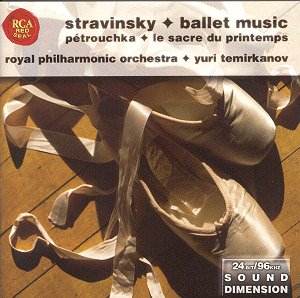
Igor STRAVINSKY (1882–1971)
Pétrouchka (1919 version)
Le Sacre du Printemps
Royal Philharmonic Band / Yuri Temirkanov
Recorded 1988, venue not given
RCA RED SEAL 74321 68020 2 [71:17]
The trouble with encountering Temirkanov’s Stravinsky after immersion in Gergiev’s recent Kirov Sacre on Philips is rather like moving from champagne to tap water—both liquids, technically speaking, but the comparison stops there. For several weeks I’d been living with Gergiev’s astonishing recording, a performance that strips away decades of accumulated interpretative varnish to reveal something raw and genuinely frightening. The earth shakes.
Literally. Temirkanov’s approach is the polar opposite, and not in any interesting dialectical sense. The RPO plays with reasonable technical competence—intonation mostly secure, ensemble adequate—but the rendition never catches fire.
Or even smolders. Where Gergiev’s forces unleash primeval violence, Temirkanov’s simply make noise, and there’s a world of difference between the two. Listen to “The Augurs of Spring” early in Le Sacre: those infamous repeated chords should feel orgiastic, dangerous, barely controlled.
Here they merely thump along, dutiful but earthbound. The bass drums don’t shake foundations; they just… thump.
The tubas and trombones, which should roar and snarl, produce volume without menace. Part of this is sonic. The Kirov recording captures extraordinary dynamic range, from whispered stillness to genuinely terrifying climaxes.
But fundamentally it’s about interpretative courage—Gergiev takes risks that sometimes don’t quite come off (that silent pause before the final chord will infuriate some listeners) but more often yield revelatory results. Temirkanov plays it safe throughout, and — well — in this music safety equals death. The 1919 Pétrouchka that opens the disc suffers from similar problems, though perhaps less acutely.
“The Shrovetide Fair” marked vivace feels sluggish in spirit if not strictly in tempo—there’s no sense of teeming carnival life, just notes being played. Worse, the opening bars reveal a recessed string sound that’s genuinely unpleasant, muffled and distant when it should sparkle. The “Russian Dance” has more energy, but character remains elusive.
These are generic Russians dancing, not Stravinsky’s specific grotesques. I’m aware that comparing a budget release to a full-price new recording isn’t entirely fair. But the market for Stravinsky’s ballet scores is crowded, and at every price point there are superior alternatives.
The warm acoustics of the concert hall seem to breathe through the recording.
Stravinsky’s own 1960 Columbia Symphony Sacre on Sony (mid-price) remains indispensable—not flawless, but fascinating as both performance and historical document. The composer knew what he wanted, even if the orchestra couldn’t always deliver it. And if one can stretch to full price, Gergiev’s Kirov disc is simply the most commanding modern Sacre I’ve encountered, by a considerable margin.
At roughly five pounds this disc might serve as a budget introduction for listeners entirely new to these scores. Otherwise there’s little reason to choose it. The performances lack both technical refinement and interpretative personality—a fatal combination in repertoire that demands both.
Competent but colorless, safe but dull. Stravinsky’s revolutionary ballets deserve better advocacy than this. Christopher Thomas