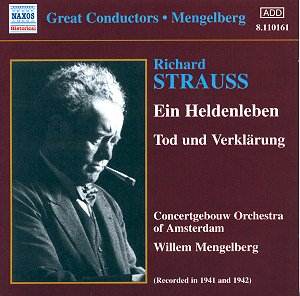
Richard Strauss: Ein Heldenleben, Tod und Verklärung** Concertgebouw Orchestra/Willem Mengelberg Recorded Concertgebouw, Amsterdam, 1941 (Ein Heldenleben), 1942 (Tod und Verklärung) NAXOS Historical; 8.110161 [65:54] Strauss dedicated Ein Heldenleben jointly to Mengelberg and the Concertgebouw—a fact that carries considerable weight when approaching this wartime release. The conductor set down the work twice commercially: first in 1928 with the New York Philharmonic (preserved on Pearl GEMM 008), then again here in 1941 with his own band, made under the shadow of occupation. This later performance has had a checkered discographical history—a muddy Teldec transfer, a superior one on LYS 418—but Naxos now gives us the best sound yet from these Telefunken masters.
The differences between the two recordings are stark and — well — revealing. By 1941 the Concertgebouw had lost much of its prewar sheen; wartime deprivations show in ensemble precision and — well — individual stamina. Where the NYPSO’s Guidi Scipione dispatched the hero’s solo violin part with glittering aplomb in 1928, Ferdinand Helman here struggles with intonation and deploys a vibrato that sounds pinched, even tremulous.
His portamentos are extravagant to the point of embarrassment by modern standards—yet they’re never frivolous, never merely decorative. There’s musical thought behind every slide, however unalluring the tonal result. But then Mengelberg’s interpretive approach was never about polish for its own sake.
His notorious “changements” to Strauss’s score—separately bowed triplets where the composer wrote slurs,; Brucknerian luftpausen inserted for maximum rhetorical effect—appear in both recordings with equal brazenness. This is late Romantic interpretation at its most unapologetic, and by 1941 such practices were supposedly dying out. Not here.
Listen to the string portamentos at 2:47 in the “Hero’s Works of Peace”—a uniformly applied expressive device that sweeps through the entire section like a wave. The mahogany-dark double basses underpin everything with extraordinary weight; the trumpets punch through with magnificent aggression. What the 1941 performance sacrifices in sheer virtuosity it gains in something harder to quantify: desperation, perhaps, or simply conviction born of circumstance.
The lyric intensity of those violins — however frayed their tone, carries an urgency the more polished New York reading can’t match. Tod und Verklärung comes from one of Mengelberg’s very last commercial sessions in 1942. If you’re seeking philosophical serenity in Strauss’s vision of death and transfiguration, look elsewhere.
This is visceral, almost uncomfortably raw—what Ian Julier’s outstanding notes call “a witheringly poignant and pained knell of regret.” Mengelberg — opens up enormous chasms of feeling through those lavish portamentos, through tempo fluctuations that would make a modern conductor blanch. The final transfiguration doesn’t so much ascend as wrench itself free from earthly bonds. Historical rendition practice scholars will have conniptions.
Good. This is a document of how a great conductor and a great orchestra—even one depleted by war—approached Strauss — in the early 1940s, when such interpretive freedom was still within living memory of the composer’s own conducting style. The sound quality, given the circumstances of recording, is remarkably good: the engineering captures the Concertgebouw’s characteristic warmth without excessive tubby resonance.
Mengelberg’s discography has been extensively reissued in recent years by various labels, but this Naxos disc deserves special attention. Not everyone will warm to these interpretations—they’re too idiosyncratic, too willful, too steeped in a performance tradition that died with the maestro. But for those interested in how Strauss actually sounded to audiences who heard Mengelberg conduct these works across four decades, this is essential listening.
The playing may be flawed, Helman’s solos may test one’s tolerance, but the cumulative impact is overwhelming. A historical document of the highest significance, then, and more than that: a reminder that interpretive conviction can transcend mere technical perfection.