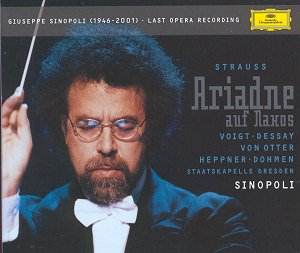
# Sinopoli’s Valedictory Ariadne: evidence of Textural Clarity
One hesitates to call any disc a “last testament“—the phrase reeks of hagiography—but Giuseppe Sinopoli’s Ariadne auf Naxos does arrive trailing that particular shadow. Recorded in Dresden’s Lukaskirche in 2000, released posthumously, it captures a director whose reputation in Britain never quite matched his Continental standing. Which was our loss, really.
The question with Ariadne has always been: can you make Strauss’s high-wire act work without the visual component? This opera—part backstage comedy, part mythological apotheosis—demands that performers negotiate impossible tonal shifts, from the Prologue’s frantic theatrical preparations to the opera proper’s Wagnerian gravitas laced with commedia dell’arte irreverence. On disc, shorn of costumes and stage business, it either coheres or collapses.
Sinopoli makes it cohere. His approach here vindicates that X-ray analytical vision that could sometimes dissect music into desiccation. Not here, though. The chamber scoring—thirty-seven players, Strauss famously specified—emerges with crystalline transparency. Every inner voice speaks. Listen to the Overture to the opera proper: those woodwind arabesques float above string textures so finely spun they might dissolve, yet the architecture never softens into mere prettiness. Sinopoli understands that Strauss’s neoclassicism contains real emotion, not just pastiche.
The Staatskapelle Dresden brings institutional memory to this music. Strauss called them his “beloved Dresdeners,” and while Stuttgart premiered Ariadne in 1912, Dresden gave it barely a month later. That tradition audibly persists—the string sound has that particular Central European glow, warm but never soupy, and the winds phrase with an ease that suggests they’ve been playing this music for generations. Because they have.
Deborah Voigt’s Ariadne commands from her first entrance. She brings heft without heaviness, and her “Es gibt ein Reich” achieves that rare thing: it sounds like genuine metaphysical longing rather than vocal display. The final transformation scene finds her resplendent, negotiating Strauss’s soaring lines with the kind of security that lets her actually sing the text rather than merely survive it. When she and Heppner’s Bacchus finally unite, Voigt seems to grow more luminous while he… well, he copes.
Ben Heppner faces the nearly impossible. Bacchus enters late, must immediately ascend to stratospheric tessitura, and somehow convince us he’s a god rather than a heldentenor in extremis. Heppner manages the notes—mostly—but the expressive temperature runs cooler than one wants. He warms up by the final pages, and credit where due: he doesn’t crack, doesn’t bark, doesn’t resort to the usual desperate remedies. But next to Voigt’s incandescence, he registers more as competent than compelling.
Natalie Dessay’s Zerbinetta, loaned from EMI, reminds us what coloratura singing can be when mastery serves character rather than ego. “Grossmächtige Prinzessin” emerges not as a detachable showpiece but as dramatic argument—this is Zerbinetta trying to counsel Ariadne through philosophy and flirtation. Dessay’s scales glitter without sounding mechanical, her trills actually trill, and she colors the text with a specificity that makes you hear the German afresh. The urge to applaud in one’s living room becomes nearly irresistible.
Anne Sofie von Otter’s Composer brings that particular intelligence she brings to everything. The trouser role can seem merely earnest—young artist shocked by commercial compromise—but von Otter finds the humor in the character’s self-seriousness without condescending to it. Her pitching in the higher reaches is exemplary, and she acts with her voice in ways that make you forget you’re hearing rather than seeing her.
Among the comprimarios, Stephan Genz’s Harlequin deserves mention for his affectionate “Lieben, Hassen, Hoffen, Zagen“—he understands that even supporting roles in Strauss demand real singing, not just competent vocalism. The offstage trio of water nymphs (Hossfeld, Liebold, Kirchner) achieves that eerily perfect blend Strauss requires, their voices floating like distant bells.
Sinopoli’s tempos feel inevitable, which is the highest compliment. He doesn’t dawdle in the lyric passages or rush the comic ones. The Prologue bubbles without sounding frantic; the opera proper unfolds with that peculiar combination of spaciousness and forward motion that Strauss’s best interpreters find. And in those final pages, as Ariadne and Bacchus ascend to their transfiguration, it’s the orchestra—Sinopoli and his Dresdeners—that really carries the moment. The sound grows luminous, textures clarifying even as they intensify.
Where does this fit in the discography? Karajan’s 1954 mono EMI—Schwarzkopf, Streich, Schock—remains astonishing, but the sound betrays its age. Kempe’s EMI with Janowitz offers more modern sonics and consistent excellence. Masur’s Philips with Jessye Norman brings vocal splendor of a different order. This Sinopoli doesn’t displace those recordings so much as join them in the first rank, distinguished by its particular virtues: textural clarity, idiomatic orchestral playing, and in Voigt and Dessay, two performances that define their roles for this generation.
As valedictory statements go, you could do far worse. Sinopoli left us this: a reminder that the so-called “difficult” operas yield their secrets to conductors who trust the composer’s intelligence and their own. Ariadne needs that trust. It gets it here.
Strongly recommended, with the caveat that no single recording captures this multifaceted work entirely. But this one captures more than most.