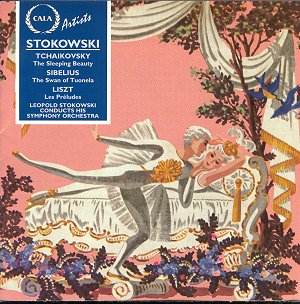
Stokowski’s 1947 Testament: Virtuosity in Search of Vision
The story of Stokowski’s wandering years after Philadelphia—and there were wanderings, make no mistake—has never quite received the attention it deserves. Between his acrimonious departure from the orchestra he had shaped into perhaps America’s most sensuously beautiful instrumental ensemble and his late-career renaissance with the Houston Symphony, he moved restlessly among ensembles, finally settling into an arrangement with RCA Victor that was part convenience, part creative compromise. They assembled for him what amounted to an all-star pickup band drawn from the NBC Symphony and New York Philharmonic rosters, christened it “Leopold Stokowski and his Symphony Orchestra,” and set him loose in the studio.
This December 1947 session captures that ensemble at something close to its peak. The personnel list reads like a who’s who of American orchestral playing: John Corigliano led the violins, William Lincer and Walter Trampler—yes, that Walter Trampler—shared the principal viola desk, and Leonard Rose anchored the cellos. Mitchell Miller’s cor anglais work in the Sibelius alone justifies the disc’s existence.
Les Préludes receives its only Stokowski recording here, and it’s a curious thing. Fiery, certainly—kinetic in the way only Stokowski could make Liszt sound, with those characteristic swooping portamentos in the strings and brass balances that would have sent Toscanini reaching for his baton to throw. But there’s something slightly manufactured about the passion, as if he’s applying his formidable technical arsenal to music he respects without quite loving. The transitions lack the inevitability one hears in his Tchaikovsky or Wagner. Still, the sheer sonic opulence is considerable, particularly in the string choir’s richly nuanced phrasing—these were players who could follow Stokowski’s famously wordless rehearsal artistry and produce exactly the kind of tonal warmth he demanded.
The Sibelius is more problematic. The Swan of Tuonela was music Stokowski returned to throughout his career (four commercial recordings between 1929 and 1976 tell their own story), yet this 1947 traversal doesn’t rank among his most illuminating. Miller’s cor anglais possesses the requisite dark beauty, floating over those string harmonics with proper Nordic melancholy, but the overall conception feels oddly literal for a director who usually found mystery in everything he touched. Compare this to his later London Symphony recording—there you hear the chill of actual death, the profound strangeness of Sibelius’s underworld. Here it’s luminous playing in search of a deeper vision.
But the real revelation is The Sleeping Beauty. Yes, the music has been “hacked around” to fit onto Victor’s DM 1205 album set—52 minutes survive from a ballet that runs nearly three hours complete—but what remains is choice. Stokowski understood Tchaikovsky’s orchestration instinctively; he knew where the composer had buried his effects and how to bring them forward without vulgarity. Listen to the way the strings phrase the great waltz, the subtle rubato that never loses the dance pulse, or the delicacy of the woodwind solos in the variations. This is conducting that honors both the music’s balletic origins and its purely symphonic virtues.
The sound itself emerges remarkably well from CALA’s remastering. The original RCA engineering was notably forward—they knew what they had in this orchestra and weren’t shy about capturing it—and seven decades haven’t diminished the impact. String tone registers with particular clarity and warmth.
What we have, then, is a decidedly mixed affair: one work that receives its only Stokowski album without quite justifying the uniqueness, another that doesn’t match his finest efforts, and a third that stands as exemplary Stokowski-Tchaikovsky despite its truncated state. The orchestra plays superbly throughout—these were musicians who could sight-read their way through anything—but great execution doesn’t always equal great interpretation.
For Stokowski completists, this is essential documentation of a fascinating transitional period. For general collectors… well, there are better Stokowskis to start with. The Sleeping Beauty suite alone, though, is worth the price of admission.