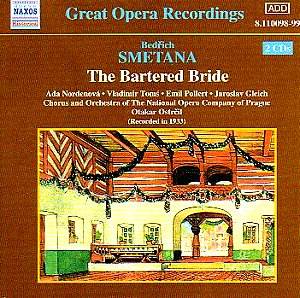
Smetana: The Bartered Bride**
Otakar Oštrcil conducts the Orchestra and Chorus of the National Opera Company of Prague
NAXOS HISTORICAL 8.110098–99 [2 CDs: 117:51]—This 1933 recording—the first complete Bartered Bride ever committed to disc—arrives now through Ward Marston’s expert remastering, and it’s a document that matters beyond mere historical curiosity. What we have here is an ensemble at the absolute peak of its powers, caught in Vienna during those last flickering years before Europe’s darkness descended.
The thing announces itself immediately in the overture. Oštrcil takes it at a clip that would make many modern conductors nervous—but there’s no scrambling, no sense of desperation. Just urgency and wit. The Prague orchestra plays with that particular Czech inflection that no amount of technical polish can replicate: slightly nasal winds, strings with a tang to them, brass that knows how to bark without being rude about it.
Ada Nordenová’s Mařenka is the vocal heart of this set. She brings to “Kdybych se co takového” a combination of girlish charm and dramatic steel that reminds you why this role needs more than just a pretty voice—it needs character. Her lower register has a smoky quality; up top, she thins a bit, but never unpleasantly. Vladimír Toms as Jeník possesses one of those clear, slightly reedy Czech tenors that cut through the texture without effort. In their Act II duet, you hear two singers who’ve done this together dozens of times, who know exactly when to yield and when to press.
Emil Pollert’s Kecal is—well, it’s definitive, really. The marriage broker’s patter songs could easily become mere bluster, but Pollert finds genuine comedy in the role’s pomposity. Listen to how he colors individual words, how he shapes phrases with a comedian’s timing. When he finally realizes he’s been outwitted, the deflation is palpable.
The ensemble work throughout is what truly distinguishes this album from later, more “polished” efforts. These singers breathe together. The Act I "finale", with its overlapping vocal lines and the chorus surging underneath, has an organic quality—controlled chaos, if you will. Oštrcil keeps it all moving forward without ever letting the structure collapse. His conducting throughout shows a man who understood that The Bartered Bride is a comedy, yes, but one with genuine emotion underneath the farce.
Marston’s remastering gives us remarkably clean vocal reproduction for 1933. The surfaces are quiet, the voices present and immediate. The orchestra, unfortunately, remains somewhat opaque—you can follow what’s happening, but the inner voices blur together, particularly in the busier passages. The famous dances lose some of their instrumental color, though the rhythmic snap remains intact.
One does miss a libretto. Naxos provides plot summaries, which help orient newcomers but leave those of us who want to follow Sabina’s text word-by-word somewhat frustrated. The Supraphon set with Gabriela Beňačková offers better sound and full texts—but it also runs to three discs and costs considerably more. That recording, fine as it is, also represents a different aesthetic: international opera house style versus this set’s more intimate, specifically Czech approach.
What strikes me most, returning to this after years away, is how much these performers clearly enjoy what they’re doing. There’s a sense of play here, of genuine theatrical imagination at work. When the circus performers arrive in Act III, you can almost see the costumes and smell the greasepaint. Karel Hruška as the Principal gives his announcements just the right touch of charlatan grandeur.
The recording captures a particular moment in Czech rendition practice—before the war, before the changes that would reshape Prague’s musical institutions, before international style began to smooth away regional characteristics. It’s not perfect. The orchestral sound is limited, some voices show their age, and modern ears may find the tempos occasionally breathless.
But this Bartered Bride has something many later recordings lack: it sounds like an actual village celebration, messy and vital and human. For that alone—and for Nordenová’s Mařenka, for Pollert’s Kecal, for Oštrcil’s propulsive conducting—it deserves a place in any serious collection of Czech opera. At Naxos’s price, it’s essentially mandatory.