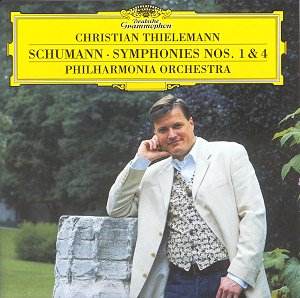
Schumann: Symphonies Nos. 1 and 4
Philharmonia Orchestra / Christian Thielemann
DG 469 700–2 [68:48]
There’s an elephant in the room with this Schumann Fourth, and its name is Furtwängler.
Actually, that’s putting it too mildly. What Thielemann has done here amounts to something between homage and séance—an attempt to resurrect, bar by bar and breath by breath, the 1953 Berlin release that for many of us (myself included, I confess) has defined this symphony’s expressive possibilities. That opening motto, followed by its crescendo to the offbeat orchestral crash: Thielemann stretches the upbeat with exactly that Furtwänglerian audacity, that sense of time suspended over an abyss. The introduction then unfolds in those same characteristic waves, breaking into a Lebhaft that’s deliberate yet urgent, full of the Master’s remembered surgings and slackenings.
The Philharmonia responds magnificently—alert, committed, technically impeccable. The string tone in the Romanze has that burnished warmth, the woodwind choir blends with uncommon sensitivity. Thielemann clearly knows how to make an orchestra sing. But here’s the rub: he’s made them sing someone else’s song.
I kept waiting for the interpretation to declare its independence, to veer off into territory that belonged to Thielemann alone. It never quite does. Those D major serenities in the first movement—they’re beautifully shaped, yes, but they sometimes lose tension where Furtwängler maintained an almost unbearable tautness beneath the surface calm. The long pause between first and second movements (which I’d always half-suspected was an engineering accident in the original) is reproduced to the second. The broken phrasing in the Romanze, the sunset dying of the "Scherzo", the full Wagnerian apparatus in that famous build to the "finale"—it’s all there, meticulously recreated.
And yet something essential is missing. Furtwängler sounded like he was discovering these gestures in the moment, pulled by forces beyond his conscious control. Thielemann, for all his mastery, sounds like he’s following a map. The difference between navigation and exploration.—The First Symphony presents a different case—thankfully, since Furtwängler’s Munich rendition hasn’t achieved the same totemic status. The opening two movements impress considerably. Thielemann’s deliberate tempos work here; he understands how to build a sequence so it grows rather than merely repeats, how to let the “Spring” motto accumulate meaning through the movement’s unfolding. The orchestral playing has real character—those horn calls in the slow movement emerge with an almost vocal directness.
But then comes the "Scherzo". “Molto vivace,” Schumann specifies. What we get is careful, beautifully phrased… and rather earthbound. The elfin quality vanishes; in its place, something more like a well-mannered minuet.
The "finale" troubles me even more. Yes, you can sidle into the main theme once, maybe twice, letting it gather momentum as you go. But every time? The cumulative effect is enervating. This movement needs to surge, to build that Schumannesque exultation that comes from a man who—let’s not forget—was still capable of throwing himself into the Rhine a few years later. Instead we get woodland tales told by the fireside, Eusebius content to doze while Florestan looks on benignly. It’s reductive, and it misreads the essential psychology. I pulled out a 1968 Celibidache performance from Milan—no one’s idea of a speed merchant—and found more overall drive, more sense of inevitable destination.
The recorded sound is outstanding, caught in All Hallows Church with warmth and clarity. The Philharmonia’s strings have bloom, the brass cuts through without harshness. Technically, this is first-rate work.
But I keep returning to the central question: what’s the point? If you want the Furtwängler Fourth, the original exists—the sound is perfectly acceptable for its age, and it has that quality of necessity that no recreation can match. If you want something different, the repertoire offers Sawallisch’s classical clarity, Karajan’s gleaming surfaces, Szell’s structural rigor, Kubelik’s lyrical warmth. (And if you can find the old Boult recordings, grab them.)
Thielemann clearly has the technical equipment and the musical intelligence to conduct distinguished Schumann. What he needs—and what these performances lack—is the courage to trust his own instincts rather than channeling the ghosts of the past. There’s a curious irony here: in trying to preserve what made Furtwängler great, Thielemann has missed the most important lesson—that greatness comes from risk, from venturing into unknown regions of one’s own soul.
An honorable effort, then, but ultimately an unnecessary one. The old records still speak more eloquently.