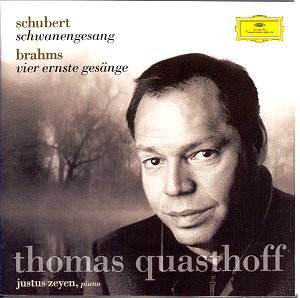
SCHUBERT: Schwanengesang, D. 957; BRAHMS: Vier ernste Gesänge, Op. 121
Thomas Quasthoff, baritone; Justus Zeyen, piano
DG 471 030-2 [65:49]
The pairing of Schubert’s and Brahms’s final songs—one man dead at thirty-one, the other at sixty-three—makes a certain kind of sense on paper.
Both composers faced mortality, both left us valedictory utterances of profound beauty. But the resemblance pretty much stops there, and I’m not sure the juxtaposition illuminates either work particularly. Readers new to this repertoire should know that “Swansong” was a publisher’s confection, not Schubert’s title.
These fourteen songs came out posthumously and don’t constitute a cycle in the narrative sense of Die schöne Müllerin or Winterreise. What we have instead is something both more haphazard and more fascinating: seven Rellstab settings that revisit the brooks and fields and distant beloveds of earlier Schubert, six Heine songs that plunge into unprecedented dramatic territory—bitter, ironic, sometimes terrifying—and then “Die Taubenpost,” a relatively cheerful piece that sits rather oddly at the end but can, in the right hands, feel like a bittersweet glimpse of happier times. Schubert himself apparently offered the Rellstab and Heine groups together to a publisher, perhaps sensing that they complemented each other.
The grouping by poet was itself a new departure. Brahms’s Four Serious Songs represents his last completed opus—the Chorale Preludes, Op. 122, lacked only final touches—and shows him rummaging through the remoter corners of Scripture, including the Apocrypha, for passages about death’s bitterness and life’s transience.
Grim stuff, you’d think. Yet in the hands of an artist like Kathleen Ferrier, these songs have consoled generations of listeners. That final setting of 1 Corinthians 13—”Though I speak with the tongues of men and of angels”—can break your heart.
The subtle intake of breath before the pianist’s attack.
Thomas Quasthoff has built a considerable reputation, and one can hear why. The voice itself is attractive: warm, sonorous, with a firm and rounded upper range. He’s clearly a natural lieder singer, attentive to text, musically intelligent.
But there are technical issues that nag. The lower range doesn’t seem particularly extensive—that low A-flat in the first part of “In der Ferne” simply evaporates long before Schubert’s done with it. Why not transpose the thing up a semitone?
One or two piano F’s get a trace of head voice, though this seems more choice than necessity. More troubling: certain vowels provoke a huskiness at the beginning of sustained tones—listen to “Tränen” and “brausender” in “Aufenthalt.” And the opening of “Der Doppelgänger” is sung so exaggeratedly pianissimo that even the microphone struggles to pick anything up. What on earth would one hear in a concert hall?
But these are quibbles compared to what’s happening at the keyboard. Justus Zeyen proves a problematic partner throughout. The demisemiquavers of “Liebesbotschaft” lack clarity—this isn’t Debussy, and Schubert demands transparency.
In “Kriegers Ahnung,” those chords on the third beat of most bars are quavers followed by a quaver rest, not staccato marcato, yet Zeyen bumps them unmusically. The rests at the beginning of “In der Ferne” aren’t counted out correctly. When the triplets start on the second page of “Der Atlas,” the rhythm remains unclear for two or three bars.
Throughout “Die Stadt —” in those pervasive chords first heard in bar 3, the middle notes consistently overbalance — the upper note—not once, which might be accident, but every time, which begins to look like carelessness. Schubert’s whole point with those accents is that the falling octave should emerge melodically. All of this pales before what happens in “Ständchen.” The quavers are chunky—let that pass.
But at the end of the singer’s first phrase — which Quasthoff rightly delivers with exquisite simplicity, the piano should echo those last two bars. Echo — I said. Instead, Zeyen inserts a huge expressive pause, as if to announce “Now watch me do it,” then splits his right-hand chord and slathers the phrase with lavish, Chopinesque rubato.
This is outright vulgarity and disqualifies the disc from serious consideration. It’s hardly worth adding that “Die Taubenpost” is actually rather enjoyable, or that Brahms’s more generalized romantic pianism suits Zeyen somewhat better than Schubert’s precision. But put on that Ferrier album—with Bruno Walter at the piano, or later with Gerald Moore—and you’ll immediately hear a tingle factor that Quasthoff’s well-schooled but earthbound singing simply can’t match.
The message is all in the last song. Ferrier could sing with the tongues of men and angels, but she also possessed that extra quality one might call love or compassion, something that brings a lump to the throat many times during the execution. If you can only sing with the tongues of men—and sing quite nicely about birds and bees and flowers—songs like these won’t yield their secrets.
They’ll only match E.M. Forster’s description in Howards End of “grumbling and grizzling.”
There’s no shortage of distinguished Schwanengesang recordings. Fischer-Dieskau remains the safest recommendation for newcomers, though Hotter, Prey, Goerne, and others all have claims.
This one doesn’t belong in that company. Christopher Howell