# Schreker Without the Shimmer
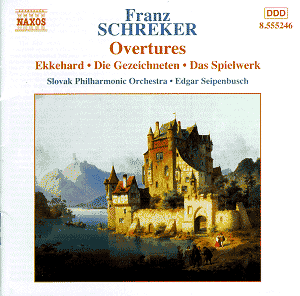
Franz Schreker: Orchestral Works
Slovak Philharmonic Orchestra / Edgar Seipenbusch
Naxos 8.555246 [54:05]
The problem with rescuing forgotten composers from oblivion is that sometimes you discover why they were forgotten in the first place. That’s too harsh on Franz Schreker—whose operas Der ferne Klang and Die Gezeichneten deserve their periodic revivals—but this Naxos disc makes a weak case for his orchestral music. And weak cases, however well-intentioned, do nobody any favors.
Schreker occupies that peculiar late-Romantic twilight zone between Strauss’s theatrical grandeur and Schoenberg’s radical experiments. Born in 1878, he should have been a major figure. He wrote operas that scandalized Vienna, taught at the Hochschule, and commanded respect until the Nazis destroyed him. His orchestration—when properly executed—can suggest perfumed gardens at midnight, all chromatic shimmer and neurotic intensity.
You’d never know it from this recording.
The program opens with juvenilia: the Ekkehard Overture and Fantastic Overture, both from around 1902 when Schreker was finding his voice. They’re apprentice works, frankly, derivative and diffuse. Echoes of early Strauss float through without the dramatic architecture that makes Strauss compelling. The melodic material meanders rather than develops. One hears ambition but not yet mastery—which would be fine if the performances brought compensatory vigor.
They don’t. Edgar Seipenbusch conducts with dutiful competence, but that’s the best one can say. The Slovak Philharmonic plays accurately enough, yet there’s a curious lack of tonal luster throughout. The strings sound undernourished in the extended passages that require shimmer and sensuality. The brass lack bite. And the woodwinds, who should emerge with those characteristic Schreker solo lines—clarinet arabesques, oboe laments—remain stubbornly recessed in the texture.
The Prelude to Die Gezeichneten deserves better. This is Schreker at his most characteristic: chromatic harmonies sliding like silk, tremolandi suggesting psychological disturbance, melodic lines that arch upward with almost painful yearning. The opera concerns Alviano, a crippled Genoese nobleman who creates an island paradise only to lose the woman he loves to a handsomer rival. The music should reek of decadence and despair.
Here it merely sounds polite. The climaxes arrive without impact—partly the orchestra’s fault, partly the recording’s. The engineering, dating from 1985 and 1987, captures a rather dull, opaque sound. Dynamic contrasts flatten out. The crucial interplay between string sections gets muddied. When Schreker piles on the orchestral forces for those characteristic late-Romantic wallops, the result sounds congested rather than overwhelming.
The Interlude from Der Schatzgräber fares somewhat better, perhaps because it’s more straightforward in construction. But even here, one misses the iridescence, the sense of orchestral color as psychological metaphor. Schreker learned from Debussy how instrumental timbre could suggest states of mind; he was also influenced by Wagner’s use of leitmotif. The combination should produce something distinctive—and it does in the right hands.
These aren’t the right hands.
I kept thinking of the Zagrosek recordings on Decca, now difficult to find but infinitely superior in capturing Schreker’s peculiar sound world. Or even the older Keilberth performances, which at least understood that this music needs sensuality, not just competence. The Prelude to Das Spielwerk, which closes the disc, exemplifies the problem: it should sound haunted, even sinister—the opera deals with a mysterious barrel organ that brings death—but instead comes across as merely vague.
Naxos deserves credit for exploring neglected repertoire, and their mid-price point makes experimentation possible. But advocacy requires more than good intentions. Schreker’s orchestral music is admittedly uneven—he was fundamentally an opera composer, and these preludes and interludes depend on theatrical context for full effect. Still, they contain enough distinctive material to reward proper attention.
This disc doesn’t provide it. The performances are adequate in the most damning sense of that word: they meet minimum requirements without illuminating anything. The disc quality, acceptable when these sessions were made in the late 1980s, now sounds dated and flat. And fifty-four minutes feels stingy for a full-price CD, even at Naxos pricing.
For Schreker newcomers, I’d recommend starting with the operas themselves—there are decent video recordings of Die Gezeichneten and Der Schatzgräber that show what the fuss was about. For collectors curious about the orchestral music, this disc might serve as a sampler, nothing more. But it won’t convert skeptics or satisfy enthusiasts.
Sometimes a composer’s cause is advanced by selective silence rather than inadequate representation. This is one of those times.