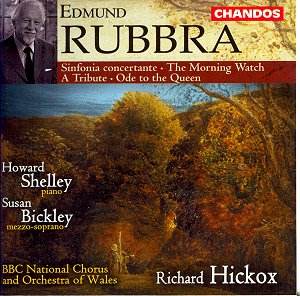
Rubbra: The Sinfonia Concertante and Choral Works
CHANDOS CHAN 9966
BBC National Orchestra of Wales/Richard Hickox
Howard Shelley, piano; Susan Bickley, mezzo-soprano
The rehabilitation of Edmund Rubbra proceeds apace—but not, I think, without certain complications that need addressing. For decades this composer suffered the indignity of being dismissed by the Glock brigade and their fellow travelers, those zealous modernists who couldn’t imagine that a man still writing tonal counterpoint in the 1960s might have something to say. The pendulum has swung back. We can hear Rubbra now without risking our reputations. But let’s not pretend, in our enthusiasm for righting old wrongs, that everything he wrote was touched by the same quality of inspiration.
The Morning Watch, for instance. Here’s a piece that opens with genuine nobility—those grave orchestral paragraphs promise something spacious and deeply felt. Then the counterpoint begins to pile up, the chorus enters, and suddenly everyone seems to be shouting different lines at cross purposes. Is this transcendental polyphony or textural overload? I suspect the Brangwyn Hall’s acoustics don’t help (that venue can turn dense scoring into sonic porridge), and perhaps the engineering favors ambience over clarity. But Rubbra himself must shoulder some blame. He could be as thick-textured and obtuse, in his own way, as any serialist—a heresy, I know, but there it is.
The choir does its level best, and there are moments when Hickox manages to clarify what amounts to a two-part invention for trumpet and high strings, with everything else registering as an indeterminate mass. I kept thinking of Stokowski’s performances of the Fifth Symphony—those readings the composer finally recognized as revealing what he’d actually written, after years of well-meaning but muddier interpretations. Small thanks to Barbirolli and Boult, who had championed this music for decades.
“A Tribute” covers similar ground in miniature—the same slow gravitas, the same contrapuntal elaborations. Does it need to exist alongside The Morning Watch? Different notes, same essential statement.
The “Ode to the Queen” opens more auspiciously. The orchestral textures have real luminosity, a transparency Rubbra didn’t always achieve in his earlier work. Susan Bickley handles the treacherous vocal line—often pushed uncomfortably high for a mezzo—with admirable security and diction. But the writing itself falls into that semi-melodic declamatory style that British composers of this generation could produce by the yard: a word needs emphasis, so up shoots the voice to a sudden high note. “Perfect emblems“—up it goes. “Gladsome welcome“—same thing. Why up rather than down? Half the time the choice seems arbitrary. The second song has genuine atmospheric imagination, and the "finale" lilts along pleasantly enough, though its ending struck me as unmotivated (the annotator calls it “surprising,” which is kinder).
But then—the Sinfonia Concertante.
Here’s the real discovery on this disc, and it’s substantial. Yes, we get the customary slow, grave opening. But Howard Shelley’s rippling piano entry announces immediately that something different is happening, that the composer is fully engaged rather than going through familiar motions. When the "Allegro" arrives it has an angry, driving power that’s genuinely riveting. The alternation of tempi throughout the movement is handled with complete mastery—no mean feat.
The “Saltarella” second movement could have been mere folksy romp. It isn’t. There’s a granitic strength to it, an elemental quality that puts it far above conventional neo-classicism.
And then the "finale"—a Prelude and Fugue written in memory of Holst. On paper, the prospect of a Rubbra fugue sounds about as appetizing as one by Max Reger (though in both cases, expectations can be confounded). But listen to how the Prelude’s moving paragraphs halt on a pure C major chord, and how the cor anglais rises from it with the fugue subject. It’s an unforgettable moment. And it’s capped—impossibly—by the piano’s entrance after an extended orchestral working of the theme. The piano comes in as if it had nothing to do with what preceded it, yet you’re immediately convinced this was the only possible way forward.
A concerto with a slow, quiet ending will never be popular. But this work surely ranks high among twentieth-century compositions for piano and orchestra, from any nation. Shelley plays with complete conviction—his understanding of the architecture is profound, his touch varied and sensitive. Hickox shapes the orchestral writing with the same commitment. They believe in this music, and they make you believe in it.
So: an essential purchase, despite my reservations about the other works. Rubbra was shamefully treated by the musical establishment. He did write masterpieces. But he didn’t write only masterpieces—what composer ever did? Now that we can actually hear a reasonable amount of his output, we need to discriminate. If you don’t know the symphonies yet, start there. But add the Sinfonia Concertante to your list of necessities. It’s a major work that deserves to be far better known than it is.