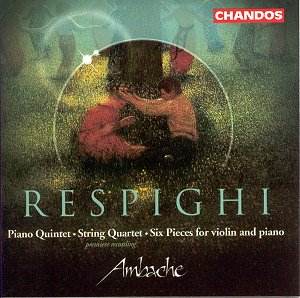
Ottorino Respighi: Piano Quintet in F Minor; String Quartet in D Minor; Six Pieces for Violin and Piano
The Ambache (Diana Ambache, piano; Marcia Crayford and Ruth Ehrlich, violins; Martin Outram, viola; Judith Herbert, cello)
Chandos CHAN 9962 [76:42]
Most of us know Respighi—if we know him at all—through those glittering Roman tone poems, those postcards from the Eternal City that orchestras trot out when they need something colorful and not too demanding. Fountains of Rome, Pines of Rome, maybe Roman Festivals if the brass section is feeling ambitious. We think of him as a brilliant orchestrator (which he certainly was) who spent too much time arranging Rossini and tarting up old Italian lute songs.
A minor master of the picturesque. This disc suggests we’ve got him all wrong. The Piano Quintet dates from 1902, when Respighi was twenty-three and still finding his voice—or rather, still deciding which voices to borrow.
Brahms is everywhere here, particularly the Brahms of the F Minor Piano Quintet, and you can hear why Rachmaninov later trusted him with orchestrating those Études-tableaux. The opening movement has that same dark urgency, that sense of struggle barely contained by classical form. But there’s something else too, a Mediterranean warmth that breaks through the northern clouds.
The slow movement—marked Lento—has a long-breathed melody that sounds like it might have wandered in from a Puccini opera, though Respighi keeps it firmly within chamber music decorum. Mostly. Diana Ambache and her colleagues play it with complete conviction, which matters enormously in music that could easily sound derivative.
The piano writing is thick, almost orchestral, and Ambache never lets it overwhelm the strings. She finds the right balance between assertiveness and collaboration. In the "finale", where Respighi suddenly shifts gears and gives us something approaching joy, the ensemble’s rhythmic vitality is infectious.
The String Quartet in D Minor comes from 1909, by which time Respighi had studied with Rimsky-Korsakov and was beginning to develop that ear for color that would serve him so well in the orchestral works. Even within the confines of four string instruments, you can hear him thinking in terms of texture and timbre. The "Presto" second movement is a genuine find—four minutes of concentrated energy that deserves to be an encore piece.
The Ambache players dig into it with relish, and Martin Outram’s viola gets some lovely moments in the trio section. But it’s the third movement that really arrests attention. Marked "Adagio", it unfolds with a kind of hushed intensity that suggests Respighi had been listening closely to late Beethoven.
The harmonic language is more adventurous here than anywhere else on the disc, with some genuinely ambiguous progressions that don’t resolve the way you expect. Ruth Ehrlich’s second violin has a particularly radiant passage about three minutes in—a descending line that seems to question everything that’s come before. The "finale" returns to more conventional ground, perhaps too conventional, but by then Respighi has earned our attention.
The Six Pieces for Violin and Piano are essentially salon music, written between 1901 and 1905 when Respighi was making his living as a violinist and needed repertoire. They’re slight, yes, but beautifully crafted. The “Berceuse” has a Fauré-like delicacy, while the “Humoresque” shows that Respighi had a lighter touch than the tone poems might suggest.
Marcia Crayford and Diana Ambache play them with affection but without sentimentality—they know these pieces are dessert, not the main course, and they don’t try to inflate them into something they’re not. The recorded sound from St. Michael’s Church, Highgate, is warm without being reverberant.
Chandos has placed the instruments in a believable acoustic space—you can hear the slight scrape of bow on string, the breathing of the players, all those details that tell you this is real music-making, not a digital construct. What emerges from this disc is a portrait of a composer with more substance than his reputation suggests. Yes, Respighi was conservative by the standards of his time—while he was writing this quartet in 1909, Schoenberg was finishing the Three Piano Pieces, op. 11. But conservatism isn’t the same as mediocrity. This is music that knows what it wants to say and says it with grace and conviction.
The Ambache deserves credit for championing this repertoire. These are committed, technically assured performances that make the strongest possible case for music that has been unjustly neglected. One hopes they’ll continue exploring Respighi’s chamber output—apparently there’s a good deal more waiting to be recorded.
This disc won’t change anyone’s fundamental view of music history. Respighi remains a figure on the periphery, looking backward even as his contemporaries pushed forward into atonality and beyond. But perhaps the periphery is where some of the most interesting work happens—work that doesn’t make the history textbooks but gives genuine pleasure to those who discover it.
Strongly recommended.