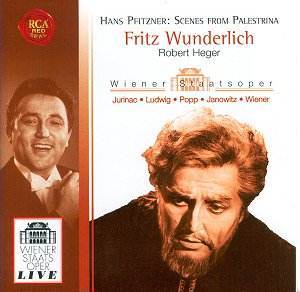
Hans Pfitzner: Palestrina* (excerpts from Acts One and — well — Three)* Fritz Wunderlich (Palestrina), Sena Jurinac (Ighino), Christa Ludwig (Silla), Otto Wiener (Borromeo), Mimi Coertse, Lucia Popp, Gundula Janowitz (Angels), Hilde Rössel-Majdan (Voice of — Lucretia) Vienna State Opera Chorus and Orchestra/Robert Heger RCA Red Seal 74321 79598 2 [79:35] Recorded live, Vienna State Opera, December 16, 1964 — The skeptics had their knives out in 1964. Fritz Wunderlich—Mozart singer par excellence, lyric tenor of crystalline beauty—cast as Palestrina? The role that Julius Patzak owned, that demanded Heldentenor heft for Pfitzner’s post-Wagnerian orchestral density?
Madness, they said. They were wrong. What emerges from this Austrian Radio broadcast, salvaged from the Vienna State Opera’s archive, is something close to miraculous: Wunderlich finding in Palestrina’s spiritual crisis a vehicle perfectly suited to his particular gifts.
Yes, he sails to that notorious top C with head voice rather than full chest—but listen to the shimmering vulnerability he brings to “Ich soll noch einmal die Kraft in mir fühlen.” This isn’t about vocal weight. It’s about a twenty-eight-year-old artist inhabiting the skin of a composer roughly his own age, wracked by; doubt, resisting ecclesiastical pressure, ultimately saving polyphonic music for the Catholic Church through sheer force of creative inspiration. The identification runs deep.
Too deep, perhaps—one hears in Wunderlich’s long-breathed phrases an almost frightening intensity, as though; he understood intuitively what Pfitzner meant when he wrote this self-portrait of the artist besieged. The voice itself remains that miraculous instrument: clarion-bright in the upper register, darkening expressively as he descends, every word etched with impeccable diction. German tenors of this caliber—singers who actually articulate—have become an endangered species.
Wunderlich’s consonants snap into place like tumblers in a lock. Robert Heger conducts with the authority of someone who knew this score from the inside. The Vienna company sounds properly Viennese—strings with that characteristic golden bloom, winds blending rather than — projecting—though the 1964 live recording catches occasional balances that wouldn’t pass muster in a studio.
No matter. What comes through is Pfitzner’s harmonic language, that peculiar mixture of late Romanticism and — well — something more astringent, more modern than his reputation as reactionary conservative would suggest. The Act One Prelude unfolds with proper gravitas — though I wish we had the complete opera rather than these excerpts.
That particular brightness of period instruments catches the ear.
Seventy-nine minutes is generous but ultimately tantalizing. The supporting cast reads like a Who’s Who of the Karajan era. Sena Jurinac brings maternal warmth to Ighino, Palestrina’s son—a trouser role that could easily turn saccharine but never does in her hands.
Christa Ludwig’s Silla has that smoky, sensuous quality she brought to everything. Otto Wiener’s Borromeo carries proper ecclesiastical authority without becoming a cardboard villain. But those three angels.
My God, those three angels. Mimi Coertse, Lucia Popp, Gundula Janowitz—three young sopranos at the beginning of major careers, blending their voices in the “Kyrie — eleison” with a purity that makes you understand why people still believed in the divine right of the Vienna State Opera. Janowitz in particular, barely out of her apprentice years, already possessed that laser-focused tone, perfectly centered, that would make her the Countess and — well — Donna Anna of her generation.
Did Vienna ever have such a constellation of talent under one roof at the same time? Perhaps in the Mahler years, perhaps under Krauss. Not often.
The tragedy of Wunderlich’s death—a stupid fall down stone stairs in September 1966, barely twenty months after this performance—hangs over this album like a shadow. He was moving toward heavier repertoire: Florestan, Walther von Stolzing. Would he have sung Parsifal?
Almost certainly. The vocal resources were there, the spiritual depth definitely was. Instead we have this—and the Taminos, the Ottavios, the Almavivas he’d already recorded—and must be grateful for what survives.
Christopher Fifield’s original liner notes (reprinted here) make the essential points, though I wish he’d said more about Heger’s conducting and the specific qualities of Pfitzner’s orchestration. This is music that resists easy categorization—neither quite Wagnerian in its harmonic language nor proto-Straussian in its orchestral palette. It occupies its own space, deliberately out of step with the modernism of Pfitzner’s contemporaries, yet more complex than mere nostalgia for a vanished world.
The sound quality is what you’d expect from a 1964 Austrian Radio broadcast: perfectly acceptable, occasionally boxy in the tuttis, catching voices with reasonable clarity though the orchestra sometimes recedes unnaturally. These are the compromises we make for historical documents of this importance. Better audio would be welcome.
Better singing? Impossible to imagine. This belongs in any serious collection of postwar German opera.
For Wunderlich alone it’s indispensable—a glimpse of roads not taken, of a career cut short just as it was expanding into new territory. But it’s also valuable as a document of Vienna at its peak, of Pfitzner’s unfairly neglected masterpiece receiving a realization of total conviction. The complete opera would have been preferable.
What we have is still essential.