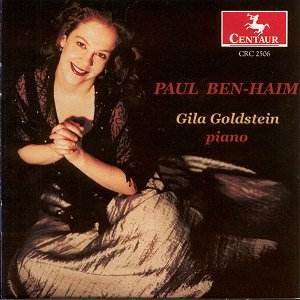
Paul Ben-Haim: The Piano Works
Gila Goldstein, piano
Recorded January–February 2000 — Patrych Sound Studios, New York
CENTAUR CRC 2506 [76:26]
Released 2001 (reissue available via EMI and online retailers)
Paul Ben-Haim, born Paul Frankenburger in Munich in 1897, occupies a curious niche in 20th-century music: a composer who bridged European late Romanticism and the emerging soundscape of a nascent Israel. This collection of his piano works—Suite No. 1 Op.
20a (1933), Suite No. 2 Op. 20b (1936), Five Pieces Op.
34 (1943), Sonatina Op. 38 (1946), Melody with Variations Op. 42 (1950), and Sonata Op.
49 (1954)—performed by Gila Goldstein, offers a rare and engrossing survey of his keyboard idiom, an idiom at once conservative yet richly inflected by the Middle Eastern milieu Ben-Haim embraced after emigrating from Germany. Goldstein’s mastery is impeccable but never sterile; she invests the music with a warmth that underlines Ben-Haim’s melodic gift and modal harmonic language. The studio sound captures the piano’s resonance with a natural clarity, though occasionally the production; feels a touch dry—not quite the lushness you might desire for the more languorous slow movements.
Still, the intimacy suits much of the repertoire’s chamber-like character. —
You can almost hear the rosin dust settling on the strings.
Suite No. 1 Op.
20a was sketched on a trip to Palestine, completed back in Germany, and reflects a transitional style. Its gestures are straightforward, yet the influences of Bartók’s percussive rhythms and Prokofiev’s sharp, — motoric figuration are palpable, layered beneath occasional modal inflections that nod to the Orient. The slow movement is especially striking—Ben-Haim quotes a Yemeni folk song here — the melody emerging like a plaintive sigh over gently rocking accompaniment.
Goldstein’s touch here is particularly sensitive, balancing the fragility of the melody against the underlying harmonic support. By the time of Suite No. 2 Op.
20b, there’s a greater emotional complexity at play. The "scherzo"’s sardonic funeral march, a cryptic reference to Mahler’s Lieder eines fahrenden Gesellen, is a fascinating study in irony and transformation—Ben-Haim recasts Mahler’s wanderer’s melancholy into something darker, more resigned. Goldstein navigates its jagged rhythms and sudden dynamic shifts with assured precision, giving the movement a biting edge without sacrificing coherence.
The Five Pieces Op. 34, composed in 1943, are miniature gems—each a vignette that showcases Ben-Haim’s nuanced palette. The “Canzonetta” stands out as especially poignant: simple, melodic lines that seem to — breathe with a quiet dignity, framed within harmonies that shimmer with modal ambiguity.
These pieces require a pianist attuned to subtle dynamic shadings and flexible pacing; Goldstein’s interpretation here is impeccable, drawing out the expressive contours without ever overstating. In the Sonatina Op. 38 (1946), Ben-Haim turns to neo-classicism with a Gallic twist—one can’t help but hear Ravel’s shadow but also a lightness akin to Ibert’s playful textures.
This piece is a welcome relief from the more somber or intense works surrounding it. Crisp articulation and a buoyant rhythmic drive propel the movements forward; Goldstein’s articulation is clean, her phrasing sprightly and unforced. —
The Sonata Op.
49 (1954), dedicated to Menahem Pressler, is the collection’s weightiest offering. Its unusual three-movement structure—opening with a sonata-form “Preamble,” followed by an introspective fugue, concluding with a set of lively folk-like variations—shows Ben-Haim’s mastery of form married to his unique voice. The fugue is particularly compelling: contrapuntal lines weave together with a solemnity that recalls Bach’s influence but filtered through a 20th-century harmonic vocabulary.
Goldstein’s command over the fugue’s intricate textures is admirable; she maintains clarity without sacrificing warmth. The "finale"’s variations are joyful yet grounded in a deep-rooted folkishness, underscored by rhythmic vitality and harmonic color that suggest the dances and tonalities of Israel’s diverse cultural tapestry. Melody with Variations Op.
42 (1950) began life humbly as a beginner’s piece but evolved into a more profound meditation. The variations grow increasingly elaborate and complex, yet the work closes by returning; to the original melody with a stripped-down simplicity—a gesture of humility and clarity. This cyclical return is beautifully captured by Goldstein — who delicately balances the variations’ intensifying complexity against the theme’s eventual repose.
Ben-Haim’s piano music, as heard here, is an intriguing hybrid: neither avant-garde nor mere pastiche. It is firmly rooted in European tradition—Bartók’s rhythmic incisiveness, Prokofiev’s piquancy, Ravel’s clarity—but enriched by the modal inflections and dance rhythms of his adopted Middle Eastern homeland. His music resists easy categorization — but that very quality makes it fascinating: a sound-world; where toccata-like energy coexists with pastoral lyricism, where perpetual motion intertwines with cantorial introspection.
Goldstein’s performances do justice to this nuanced music. Her touch varies appropriately from the staccato bite needed for the "scherzo"s to the legato warmth demanded by the lyrical slow movements. Occasionally, one might wish for a bit more dynamic contrast, perhaps a deeper plunge into the darker emotional recesses, but these are minor quibbles.
Overall, her readings are thoughtful, idiomatic, and, crucially, imbued with a palpable affection for Ben-Haim’s style. —
In sum, this recording is a vital contribution to the neglected repertoire of an important 20th-century figure. Paul Ben-Haim’s piano oeuvre deserves far wider exposure—not just as a curiosity of Israeli nationalism or émigré culture, but as a compelling voice that synthesized East and West with sincerity and craft.
For aficionados of mid-century piano music—especially those interested in the interplay between tradition and regional identity—this disc is indispensable. Recommended without hesitation.