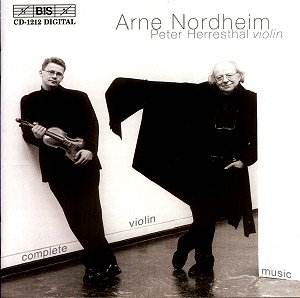
Arne Nordheim: Complete Violin Music
Concerto for Violin and Ensemble; Duplex for Violin and Cello; Partita für Paul
Peter Herresthal, violin; Øystein Sonstad, cello; Mats Claesson, electronics
Stavanger Symphony Orchestra/Eivind Aadland
BIS CD 1212 [61:39]
The warm acoustics of the concert hall seem to breathe through the album.
Nordheim at seventy—the milestone prompts reflection on a composer who spent his early career rebelling against Norwegian musical conservatism and never quite stopped. His encounter with electronic music in Paris during 1955 proved decisive, yet what makes this disc so fascinating is how thoroughly he’s remained caught between inheritance and insurgency. Not torn between them, mind you.
Caught—productively, even gloriously so. The Concerto for Violin and — well — Orchestra opens this survey with uncompromising granitic force. Nordheim once called it “one long funeral song,” which captures something of its; brooding intensity but misses the visceral violence that erupts throughout its thirty-minute span.
This is monumentality modified by reflection, to be sure, but the modification doesn’t always take. Three percussion groups multiply the sonic possibilities exponentially—Nordheim exploits every possibility for timbral contrast, from chamber-music intimacy to brass blocks of genuinely malevolent ferocity. The work’s dramaturgy depends on extreme contrasts that somehow cohere.
Around 12:14, an oboe’s winding figure emerges from dense brass and high woodwind—perfectly balanced by Eivind Aadland, who understands that Nordheim’s orchestral writing requires both clarity and saturation. Later, at 23:41, Peter Herresthal’s solo line intensifies (his vibrato usage becomes more pronounced, almost desperate) against rich orchestral sonorities that threaten to swallow it whole. The syntax derives from late Romanticism, but Nordheim puts it to distinctly unromantic purposes.
Agitated clusters, frequently high-lying solo writing, moments of what I can only call malevolent stasis—this is funeral music that refuses to lie still. Herresthal plays with committed ferocity throughout. His tone in the upper register maintains its focus even when Nordheim pushes him to extremes, and he negotiates the work’s compound of lament and lyricism without sentimentalizing either impulse.
The Stavanger Symphony responds with impressive discipline—no mean feat given the score’s demands for explosive violence one moment, crystalline clarity the next. Duplex, originally conceived for violin and viola, appears here in a 1991 version for violin and cello. The very close miking makes the two instruments sound almost orchestral in weight—those pizzicatos explode like gunshots.
Nordheim twice marks passages “Energico,” as if we might miss the point. We don’t. This is vigorous — dynamic writing that exploits every timbral contrast between the instruments, every register difference, every dynamic extreme.
Sonstad matches Herresthal’s intensity with his own brand of controlled violence. The piece doesn’t offer much in the way of repose, but then it doesn’t seem interested in repose. The Partita für Paul was written for a Paul Klee exhibition, its five movements named after Klee paintings.
Here Nordheim’s magpie instincts serve him well—there’s a thematic resemblance to Ysaÿe that’s more than coincidental, scintillating left-hand pizzicatos, an affecting lyrical line in “Schwebendes.” The harp piece features what the Herresthals’ distinguished notes describe as “imitative pizzicato effects”—Nordheim is, as they put it memorably, “a rampant pizzicatist in solo string works.”
But the real revelation comes in the use of tape recorder with electronic delay, allowing multiple canons that conjure an extraordinary drizzling effect over a droning pedal. This is electronic music that enhances rather than overwhelms the acoustic source, a balance Nordheim learned in Paris and — well — never forgot. The piece wears its occasional nature lightly—it’s substantial without being portentous, imaginative without being merely clever.
Herresthal proves an ideal advocate throughout. His technical command is formidable, but more importantly, he seems to understand these pieces from the inside—their mixture of violence and — well — reflection, their compound of avant-garde gesture and traditional rhetoric. BIS provides its usual exemplary sound, capturing both the granite and the gossamer in Nordheim’s writing.
The recorded balance in the Concerto is particularly fine, allowing orchestral detail to emerge without sacrificing overall impact. This disc makes a strong case for Nordheim as a major voice in late twentieth-century string writing. The music doesn’t always comfort—that malevolent stasis can be genuinely unsettling—but it compels attention throughout.
At seventy, Nordheim had clearly not resolved the tension between rebellion and inheritance. On this evidence, we should be grateful he didn’t try.