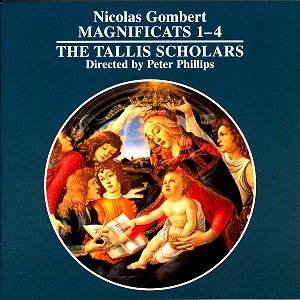
Nicolas Gombert: Magnificats 1–4 The Tallis Scholars / Peter Phillips Gimell CDGIM 037 [54:25] DDD Recorded 2000, Church of Saint Peter and Saint Paul, Salle, Norfolk Released 2001 (Universal distribution); It’s a rare enough pleasure these days to welcome a fresh Tallis Scholars release — especially one that ventures beyond their beloved, oft-returned terrain of Palestrina, Byrd, and Tallis himself. Here, Peter Phillips and his ensemble turn their immaculate attentions to Nicolas Gombert’s Magnificats 1 through 4, a cycle that has long lurked in the shadowy margins of Renaissance choral repertory. Gombert—once dismissed as a minor figure of the Flemish school—is now revealing himself with this set as an architect of dense, intricate polyphony that dares the listener to keep pace.
The premise is straightforward but rich: each Magnificat is scaffolded upon a Gregorian chant tone, which frames the liturgical text and bookends the polyphonic elaborations. This creates a tapestry that is both anchored and adventurous. It’s the kind of compositional rigor that Gombert—who served under Charles V and whose career ended in ignominy—manages to navigate with uncanny finesse.
There is a certain paradox at work here: the music’s complexity threatens to smother clarity, yet under this choir’s weightless, crystalline delivery, the textures breathe. One of the first things that strikes the ear is Gombert’s unusual doubling practice. The bass and tenor lines often march in lockstep, doubled to reinforce the harmonic foundation, while the soprano remains a single, unadorned thread, soaring and limpid.
Altos occasionally duplicate, but sparingly. This creates a sound world that is unusually bottom-heavy for its time — lending a warm, almost velvety density without ever becoming muddy. The effect is subtle—like the hushed murmur of bees in a sun-dappled garden—yet it imparts a richness that invites repeated listening.
Phillips’s Tallis Scholars excel at the clarity of inner lines which, in Gombert’s labyrinthine counterpoint, is no mean feat. Each voice is carved out with surgical precision; consonances and suspensions bloom with refined tension, while the choir’s impeccable diction lets the Latin text breathe. The release venue, with its resonant stone walls, captures the ensemble’s seamless blend and the chant tones with crystalline presence, inviting the listener into a space both sacred and immediate.
Now, about those infamous “English clashes.” The momentary dissonances at cadences—where tensions are not resolved but deliberately retained—can sound like sonic razor edges to ears accustomed to smoother closures. Yet Gombert’s deployment of these clashes is far from gratuitous; they inject a moment’s; jolt, a dramatic jangle that catches the breath and underscores the gravity of the text. Hearing them performed, rather than just reading about them in theory, is revelatory.
You can almost hear the rosin dust settling on the strings.
Phillips does not shy away, allowing these moments to ring out, exactly as the composer intended. Structurally, each Magnificat unfolds methodically. The opening four-voice sections gradually swell into passages where six voices intertwine, often compressed within a narrow pitch range.
This creates a dense polyphonic fabric that skirts the edge of sonic congestion but never quite falls into it. It’s like watching a master calligrapher work with the narrowest of nibs—every flourish packed with meaning and ultimately satisfying. Gombert’s commitment to preserving the chant’s pitch contours adds an extra layer of complexity; he effectively writes himself into a tonal corner — yet manages to find unexpected pathways.
One cannot ignore the biographical shadows behind these works. Gombert’s imprisonment on a galley—ordered by Charles V himself—casts a somber pall. These Magnificats may well have been composed in a spirit of penitence, or as a bid for redemption.
It’s a reminder that, behind the sublime polyphony, there lurks a complicated human story, one that challenges us to separate art from artist without erasing context…. In the end, this release is as much a triumph of rendition as it is of repertoire. These are not easy works, but the Tallis Scholars meet their challenges head-on with unfaltering clarity, tonal purity, and — well — a palpable sense of devotion.
For all their density and occasional thorniness, Gombert’s Magnificats reveal themselves here as profound expressions of faith and contrapuntal mastery. If you already treasure the Tallis Scholars’ catalog, this is essential — a rare chance to hear something new yet unmistakably of their trademark standard. And for those new to Gombert, this recording serves as a compelling introduction to a composer who deserves nothing less than a full reappraisal.
A remarkable issue — highly recommended and a welcome addition to the Renaissance choral discography.