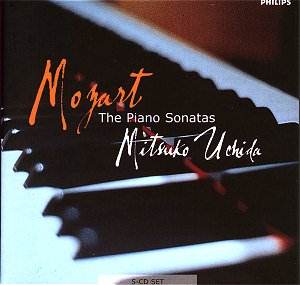
Wolfgang Amadeus Mozart: Piano Sonatas
Mitsuko Uchida, piano
Philips 468 356-2 (5 CDs: 328:16)
Recorded 1983-1987, Henry Wood Hall, London
There are complete Mozart sonata cycles, and then there is this one. Mitsuko Uchida’s traversal of these eighteen works—recorded across four years in the mid-1980s at Henry Wood Hall—remains one of those rare achievements where — technical command, stylistic insight, and — well — something harder to name (call it spiritual affinity) converge so completely that criticism almost seems beside the point. Almost.
Because what Uchida accomplishes here deserves more than reverent silence; it demands close attention to how she reimagines Mozart’s keyboard world without a trace of interpretive aggression. The early sonatas, K. 279-284, composed in Munich when Mozart was nineteen, already reveal Uchida’s approach.
Where other pianists emphasize the galant conventions or push toward Beethovenian drama that isn’t — yet there, she finds something more elusive—the young composer’s delight in purely musical argument. Listen to the "finale" of K. 284, that set of variations Mozart clearly intended as a showpiece.
Uchida’s fingerwork is immaculate, yes, but she never uses virtuosity as an end. Each variation breathes at its own tempo, each ornament feels discovered rather than applied. The left hand in the ninth variation—those treacherous Alberti patterns—emerges with a transparency that lets you hear the harmonic motion underneath, not just brilliant passage-work.
The darker sonatas receive performances of particular distinction. K. 310 in A minor, written in Paris shortly after his mother’s death, can sound merely turbulent.
Uchida finds something more complex: anger, certainly, but also a kind of bewildered grief in the development section’s harmonic wanderings. She doesn’t sentimentalize the "Andante" cantabile—that would be fatal—but there’s an inwardness to her phrasing, a reluctance to let melodic lines fully resolve, that suggests private mourning rather than public display. The "finale"’s fury never becomes percussive; even at full volume, her tone retains its core.
Similarly, the great C minor Sonata, K. 457 (here properly paired with the Fantasia in C minor, K. 475), benefits from Uchida’s refusal to impose.
The Fantasia’s improvisatory character—those abrupt shifts between "Adagio" and "Allegro", the enharmonic modulations that seem to lose their way deliberately—emerges as written-down spontaneity, which is precisely the paradox Mozart intended. When the sonata proper begins, Uchida establishes the main theme with almost dangerous restraint. No pounding octaves, no underlining of the obvious drama.
The result is that when intensity does arrive—in the development, in that astonishing coda—it feels earned, inevitable. Her approach to the so-called “easy” sonatas proves equally revelatory. K.
545, the “Sonata semplice,” is no pedagogical exercise here. Uchida takes Mozart at his word—this is simple music, but simplicity in Mozart’s hands becomes a kind of perfection that resists improvement. The right-hand melody in the "Andante" sings without ever becoming precious; the Alberti bass maintains its purpose as harmonic scaffolding, not mere accompaniment.
And the "finale"’s two-part writing—deceptively difficult to balance—achieves that ideal transparency where you hear both voices as equal partners in a conversation. The famous K. 331, with its “"Rondo" alla turca,” presents particular dangers.
That "finale" has been murdered by ten thousand piano students; Uchida resurrects it. Her tempo is brisk but not frantic, her articulation crisp without hardness. She understands that Mozart’s “Turkish” music is sophisticated play-acting, not ethnic tourism, and — well — she plays it with wit rather than bombast.
The preceding variations on the "Andante" grazioso—the movement that actually matters—receive performances of extraordinary subtlety. Uchida’s dynamic range here, from barely audible pianissimos to full-voiced climaxes, reminds you that Mozart wrote this for his own concert use, not for drawing-room amateurs. Throughout these five discs, Uchida’s ornament choices strike me as nearly ideal.
She adds tasteful embellishments where appropriate—Mozart expected it—but never calls attention to her scholarship. The trills sing, the turns flow, the appoggiaturas land exactly where they should. In slow movements particularly, her melodic elaborations feel like Mozart thinking aloud, testing expressive possibilities without violating the written line’s essential character.
The recorded sound — now more than two decades old, holds up remarkably well. Philips captured Uchida’s Steinway with admirable directness—close enough to hear the action, distant enough to preserve the instrument’s natural bloom. Henry Wood Hall’s modest acoustic provides just enough warmth without blurring attacks or obscuring inner voices.
Modern digital recordings sometimes achieve greater transparency, but they rarely capture a piano’s physical presence with this much truth. One might wish Philips had included the remaining solo works—the variations sets, the other fantasias, the early pieces. A genuinely complete Uchida Mozart would be something to treasure.
But these eighteen sonatas and one fantasia constitute the core repertoire, and Uchida’s interpretations set a standard that subsequent recordings must reckon with. Some pianists bring more overt personality to Mozart: Brendel’s intellectual rigor — Perahia’s singing legato, Pires’s aristocratic poise. Uchida brings something different—a kind of self-effacing mastery that lets Mozart’s music speak without interpretive mediation.
This sounds easier than it is. The ego required to perform at this level must somehow be reconciled with the humility to serve the composer’s intentions. Uchida manages that balance more consistently than anyone else on record.
After nearly four decades, this cycle remains indispensable. Not the only way to play Mozart — certainly—no such thing exists. But a way that honors the music’s complexity, its emotional range, its formal perfection without ever sounding studied or academic.
Uchida plays as if she’s discovering these works for the first time while knowing them completely. That’s the paradox at the heart of great interpretation, and she achieves it here with seemingly effortless grace. Essential listening.