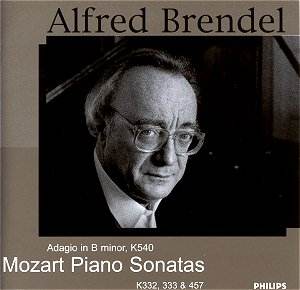
Mozart Piano Sonatas
Alfred Brendel
Philips 468 048–2 [74:36]
There’s something quietly momentous about hearing a great artist come late to repertoire he’s avoided for decades. Brendel—who built a career on Mozart’s concertos, album them with distinction since the beginning—held back from the sonatas with what seems to have been genuine uncertainty about his affinity for them. This disc, recorded in 2000 when the pianist was nearing seventy, suggests he was right to wait.
The opening of K. 332 gives pause, though. This is magisterial Mozart in the Klemperer manner—steady, imposing, beautifully structured, but just a shade too demonstrative. One admires the architecture without quite inhabiting it. I thought of Sviatoslav Richter’s sometimes didactic approach to this composer (there’s a 1966 Aldeburgh recital on BBC Legends that shows both sides of that coin), and wondered if we were in for an hour of noble but slightly remote pianism.
Then the "Adagio" arrives and everything shifts.
Listen to what Brendel does with the so-called Alberti bass—those routine left-hand figures that most pianists treat as mere accompaniment. He transforms them into a gentle rocking motion, a poem in themselves. The repeated notes under the second theme acquire an almost conversational intimacy, as if Mozart were confiding something just to you. The "finale" sweeps away any lingering reservations: this is real improvisation, or sounds like it. Notice how naturally he slides into the dolce melody after the opening cascade, how tenderly he shapes those minor-key episodes. He even tosses in decorations here and there—did he invent them on the spot?—that feel utterly spontaneous.
K. 333 shows yet another Brendel, graceful and disarmingly flexible. Throughout the disc there’s a delightful inconsistency in how he voices chords—split one time, together the next—that contributes to the illusion we’re hearing him work things out before a circle of privileged friends. His sensitivity to key color is remarkable: when the music moves into E flat major, the sound becomes palpably warmer, almost golden. The "finale"’s second episode erupts with sudden impetuous accents on those syncopated left-hand chords. It’s thrilling.
The C minor Sonata, K. 457, brings the impetuosity into sharper relief—the outer movements crackle with energy, the triplets in the first movement even pushing the tempo forward slightly. But it’s the "Adagio" that will likely endure as a classic of Mozart interpretation. Brendel’s ear for harmonic coloring reaches its peak here. After the warm E flat opening, a shaft of light seems to enter when the music shifts to B flat. Then, as Mozart ventures deep into the flat keys, the sound grows richer and richer, darker and more inward.
At one point in the G flat major episode, Brendel brings out the lower voice in the right hand rather than the upper. I’d love to know his reasoning—surely he’s drawing our attention to that particular motive for some specific musical reason. These are the choices that separate great Mozart playing from merely competent Mozart playing.
The B minor "Adagio", K. 540, finds him slightly more didactic again. Ronald Brautigam’s recent period-instrument recording (on BIS) moves this long piece along with more overt passion. But even when Brendel turns pedagogical—and we’re talking about perhaps two movements out of the ten pieces here—he makes unmistakably clear that these are great sonatas, classics worthy of standing beside Beethoven and the finest Haydn. That’s not always evident in the hands of younger players.
The sound is outstanding—both Snape Maltings and Glyndebourne provided sympathetic acoustics. Unlike Arrau, who also came to these sonatas in late maturity and brought his full Steinway weight to them, Brendel keeps his instrument (presumably a Steinway) remarkably lithe and slender. The tone never becomes heavy or opaque.
If you’re committed to period instruments, these won’t be for you, though I’d urge you to try them anyway. The claims of Gieseking’s classic recordings remain strong for those who don’t insist on modern sound. But much here—especially that C minor slow movement, those spontaneous-sounding ornaments, the sheer variety of approach from one sonata to the next—will surely be studied by future generations as definitive examples both of how to perform these works and of Brendel’s particular pianistic genius.
What emerges is that happy marriage between deep artistic maturity and something like first delight. Worth the wait.