# Richter’s Final Bow with Orchestra: An Uneven Testament
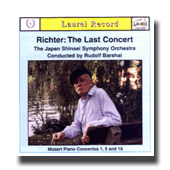
MOZART: Piano Concertos Nos. 1 in F, K. 37; 5 in D, K. 175; 18 in B-flat, K. 456
Sviatoslav Richter, piano; Japan Shinsei Symphony Orchestra/Rudolf Barshai
Laurel LR-902 [74:53]
This disc arrives bearing a title both accurate and misleading. Yes, this Tokyo concert from March 1993 represents Richter’s final recorded appearance with orchestra—he would live another four years, retreating further into chamber music and solo recitals in dimly-lit halls where his nerves troubled him less. But “last” implies culmination, summation, perhaps even valediction. What we get instead is something more complicated, more human: a great artist’s partial vision, compromised by circumstances, illuminated by flashes of the old mastery.
The repertoire choices intrigue. Richter recorded surprisingly little Mozart—the E-flat K. 482 and C major K. 503 constitute nearly his entire concerto legacy—and these early works (if we can call K. 456 early; Mozart was twenty-eight, hardly a child) seem almost perverse selections for a farewell. K. 37 isn’t even Mozart’s original music—it’s a pasticcio arrangement of movements by Raupach and Honauer, assembled when the boy was eleven. K. 175, from his seventeenth year, shows genuine invention but remains apprentice work. Only K. 456, written for the blind pianist Maria Theresia von Paradis, achieves the profundity we associate with Mozart’s maturity.
Yet there’s method here. Richter always gravitated toward Barshai in his later years—the Russian maestro understood his tempos, his need for structural clarity over romantic indulgence. And these concertos, stripped of late Mozart’s metaphysical depths, allow for the kind of crystalline transparency that Richter, even at seventy-eight, could still command.
The K. 37 emerges with surprising charm. Richter treats the opening "Allegro" with brisk efficiency—no lingering over prettiness, but a directness that honors the music’s salon origins without condescension. His tone, captured in Suntory Hall’s slightly over-bright acoustic, retains that distinctive ping in the upper register, that refusal to blur articulation for easy beauty. Listen to how he shapes the second movement’s "Andante": each phrase ends with the slightest withdrawal of sound, not a diminuendo so much as a sudden absence, like breath held. The Japan Shinsei Symphony responds with admirable delicacy, though the woodwinds—particularly the oboe—sound a touch tentative in their exposed passages.
K. 175 presents greater challenges, and here the interpretation shows its age more plainly. Richter’s fingers remain precise in the first movement’s passagework, but the cumulative effect lacks the architectural sweep he once commanded. The slow movement fares better; his restraint serves Mozart’s simple melodic lines, and there’s genuine poetry in his treatment of the ornamentation. But then comes that gaping hole in the "finale"—no cadenza at all, just an awkward silence where invention should flower. Was this Richter’s decision? A lapse in planning? The documentation offers no explanation, and the omission mars what otherwise might have been a serviceable reading.
The B-flat Concerto, K. 456, justifies the disc’s existence. Here Richter finds his footing, and for extended passages we hear the artist Gilels warned Western audiences about. The opening movement unfolds with remarkable narrative logic—each theme emerging as inevitable consequence rather than mere succession. Richter’s left hand, so often undervalued in discussions of his mastery, provides harmonic foundation of granite solidity. The "Andante" un poco sostenuto reveals his genius for sustaining long lines without sentimentality; he plays the music’s inherent sadness without italicizing it, trusting Mozart’s progressions to do their work.
Barshai deserves credit for keeping the orchestral textures transparent—no small feat with a Japanese regional ensemble whose string sound tends toward the generalized. The horns, as Christopher Fifield noted in his original review, play with genuine character, their slightly nasal tone adding period flavor whether intended or not. But ensemble precision wavers in tutti passages, and the recorded sound, while clear, lacks the warmth that might have softened the rough edges.
Technical reservations aside, this document matters. Not as definitive Mozart, certainly not as representative Richter—for that, seek out his Schubert, his Beethoven sonatas, his chamber music with Britten. But as evidence of an artist who, even in decline, even battling the demons that made public performance torture, could still locate truth in musical line. That quality of attention never left him. The fingers might have lost some velocity, the nerves might have frayed further, but the listening—that profound, almost mystical listening that made Richter unique—that remained.
The market offers better-played Mozart, better-recorded Richter. But for those who followed this tortured genius through his long career, who understood that his greatness lay not in extroversion but in an almost unbearable inwardness, this valedictory appearance offers its rewards. Flawed testament from an artist who never stopped searching, even when the search grew painful to witness.