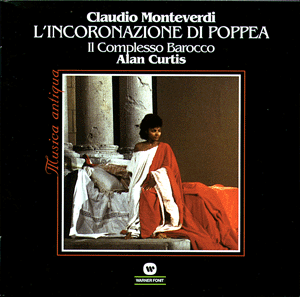
Monteverdi: L’incoronazione di Poppea**
Carolyn Watkinson (Nerone), Carmen Balthorp (Poppea), Andrea Bierbaum (Ottavia), Judith Nelson (Drusilla), Henri Ledroit (Ottone), Ulrik Cold (Seneca), Peter Ratinckx (Amore)
Il Complesso Barocco/Alan Curtis
Warner Fonit Music Antiqua 8573 84065-2 [3 CDs: 76:13, 47:20, 39:06]
Recorded live at Teatro La Fenice, Venice, September 1980
The director’s presence feels palpable even in this studio setting.
Alan Curtis has always been a scholar first, showman second—sometimes to his credit, occasionally to his peril. This 1980 La Fenice execution of Monteverdi’s final opera represents one of his most ambitious attempts at what he calls “greater authenticity,” stripping away the accretions of centuries to reach something closer to what Venetian audiences might have heard at the Carnival of 1642. Whether he succeeds is another matter entirely.
The textual problems surrounding Poppea are notorious. No autograph score survives. What we have are manuscripts riddled with inconsistencies, possible interpolations by Cavalli or Sacrati, and — well — enough lacunae to keep musicologists employed for generations.
Curtis has made his choices—eliminating what he considers spurious additions, simplifying continuo textures, paring back the instrumental forces to a chamber ensemble. The result sounds lean, almost ascetic at times — with that characteristic bite of gut strings and the harpsichord’s plangent commentary threading through the recitatives. But here’s the rub: this is a live recording, and the engineers have bungled it rather spectacularly.
The instrumental ensemble sits too far forward in the acoustic space of La; Fenice, while the singers—some of them quite distinguished—recede into an unfocused middle distance. Balances shift unpredictably. One moment Carolyn Watkinson’s Nerone emerges with startling presence; the next, she’s singing from somewhere behind a scrim.
It’s maddening, particularly when you can hear the quality of the vocal work being obscured. And there is quality here. Watkinson brings a cool, androgynous sensuality to Nero that feels psychologically acute—this is an emperor whose cruelty stems from aesthetic detachment rather than hot passion.
Her ornamentation has genuine spontaneity, those little mordents and turns flowering naturally from the dramatic situation rather than being applied like cosmetic enhancement. Carmen Balthorp’s Poppea strikes the right balance between ingénue and schemer; her voice has a silvery sheen that darkens subtly as her character’s ambitions crystallize. The duet “Pur ti miro”—if indeed it’s by Monteverdi, which remains disputed—achieves genuine erotic languor despite the sonic handicaps.
Judith Nelson, always a singer of refined intelligence, makes much of Drusilla’s relatively brief appearance. Her phrasing has that particular clarity I associate with the best English early music specialists—every word matters, every melodic gesture serves the text. Andrea Bierbaum’s Ottavia suffers most from the album’s inadequacies; her mezzo has warmth and body, but she keeps disappearing into the murk.
You strain to hear the bitterness in “Addio Roma,” which should lacerate. The men present a more mixed picture. Ulrik Cold’s Seneca wobbles alarmingly—one could be charitable and call it the tremor of age, but I suspect it’s simply insecure skill.
His death scene lacks the stoic grandeur Monteverdi surely intended. Henri Ledroit’s alto counter-tenor Ottone has an appealing fragility, though the tone turns breathy under pressure. As for Peter Ratinckx’s Amore in the Prologue—well, the less said the better.
That particular timbre suggests someone wrestling with a vocal production that refuses to cooperate. Curtis’s pacing generally feels right. He understands that Monteverdi’s recitative needs to breathe, that these characters speak before they sing.
The continuo team (uncredited in the documentation, maddeningly) provides idiomatic support, though the harpsichord occasionally sounds as if it’s in a different theater altogether. Some stage noise intrudes—footfalls, a chair scraping—but nothing catastrophic. The scholarly apparatus disappoints.
We get the Italian libretto but no translation, which seems perverse for a mid-price reissue aimed at a general audience. The essay rambles without saying much of substance. No vocal registers are listed in the booklet, forcing listeners to deduce who’s singing — what—an odd omission for an opera that deliberately plays with gender and voice type.
So where does this leave us? If you’re fascinated by the archaeology of early opera performance, if you want to hear Curtis’s particular vision of a stripped-down Poppea, there’s value here. Watkinson, Balthrop, and Nelson justify the price of admission.
But the sonic compromises are real, and they undermine what should be the glory of; this approach: clarity, transparency, the ability to hear every strand of Monteverdi’s astonishingly modern dramatic writing. For a first encounter with this inexhaustibly rich work—Monteverdi’s most psychologically penetrating opera, his farewell to the stage—look elsewhere. Jacobs, Harnoncourt, even the old Leppard version with its Victorian plushness, serve the music better.
This remains a document of specialized interest, a footnote in the performance history of a masterpiece that deserves center stage.