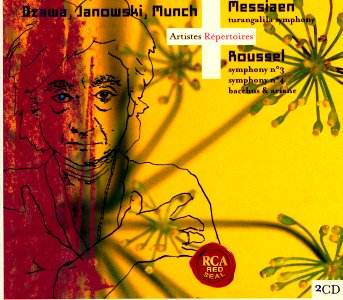
# Messiaen and Roussel: A Bargain Bonanza with Caveats
RCA has done something both generous and slightly maddening here—throwing together four recordings from three different decades, hoping the sheer value will override questions about coherence. Does it work? Mostly, yes.
The Turangalîla-Symphonie occupies the entire first disc, all 77 minutes of it, and this 1967 Toronto performance under Ozawa remains a knockout. I remember when this LP appeared—it caused genuine excitement, not least because Messiaen’s elephantine love-fest wasn’t yet the repertory staple it has become. Ozawa approaches the work with the only sensible strategy: total commitment, no apologies, maximum color. The Toronto Symphony plays magnificently, though I suspect the RCA engineers deserve equal billing for the sonic pyrotechnics.
And here’s where things get complicated. RCA’s house sound from this era has that characteristic front-lit brilliance—you’re practically sitting in the trumpet section, everything gleaming and immediate. Thrilling, certainly. But there’s a flatness to the perspective that can fatigue the ear over extended listening, and Turangalîla is nothing if not extended. The ondes Martenot wails and swoops with appropriate otherworldliness, Yvonne Loriod (Messiaen’s muse and eventual wife) commands the piano part with her usual steely authority. Yet I confess—and I’ve never hidden this—Messiaen’s aesthetic leaves me cold more often than not. The relentless ecstasy, the Tristan-and-Isolde-on-steroids eroticism… it’s a lot. If you’re going to sell me on this piece, though, Ozawa makes the best case possible.
One oddity: the CD transfer reveals traffic noise—actual traffic—audible behind the ending of “Jardin du sommeil d’amour.” Charming in its way, I suppose, a reminder that even epochal recordings happen in real time and space.
The second disc offers more consistent pleasures. Albert Roussel remains criminally undervalued—a composer who managed to synthesize French clarity with genuine symphonic heft, no mean feat in an era when French composers often seemed allergic to Germanic formal ambitions. Marek Janowski’s 1994 recordings of the Third and Fourth Symphonies with the Orchestre Philharmonique de Radio France are outstanding: crisp, energetic, idiomatically colored without sounding provincial.
The Third Symphony packs remarkable substance into its modest 24-minute span. That opening movement, with its motoristic drive and bright orchestral palette, announces Roussel’s mature style—neoclassical in outline but too rhythmically vital, too harmonically piquant to sound merely derivative. The slow movement builds to a genuinely impassioned climax (Janowski doesn’t shortchange the emotional weight here), while the "scherzo" has that slightly raffish quality that makes me smile every time. One reviewer mentioned “Carry On film” music, which isn’t entirely wrong—there’s a cheeky insouciance to the orchestration that undercuts any pomposity.
The Fourth Symphony, composed just a year before Roussel’s death, shows no falling-off in invention or craft. Perhaps it lacks the Third’s immediate memorability, but it rewards repeated hearing. Under twenty minutes, yet it never feels rushed or insufficiently developed. Janowski maintains outstanding momentum throughout both works.
Charles Munch’s 1952 recording of the Bacchus et Ariane Suite No. 2 completes the disc, and here we encounter one of those miraculous early stereo recordings that still sounds astonishingly vivid. The Boston Symphony plays this music with real affection—Munch, after all, was a tireless Roussel advocate. The orchestral colors glow, the rhythmic vitality never flags. I do notice some string solos that sound less than ideally polished, a certain thinness in exposed passages, but this hardly diminishes the reading’s overall excellence.
The transition from Janowski’s 1994 digital sound to Munch’s 1952 vintage requires minimal mental adjustment—a testament both to RCA’s original engineering and to the quality of the remastering.
So: an odd coupling, spanning four decades of album technology, three conductors, three orchestras. The Messiaen will please those already convinced (and perhaps perplex those, like me, who find his aesthetic overripe). The Roussel material is uniformly excellent and represents the disc’s real value. At bargain price, this is essential for anyone interested in twentieth-century French music. Just don’t expect programmatic logic—think of it as a particularly generous sampler box that happens to contain some very fine performances indeed.
Recommended, with the Roussel material deserving special attention.