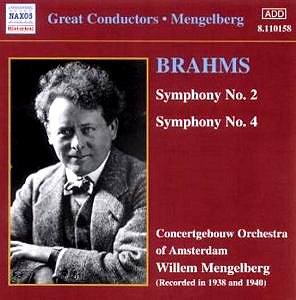
Brahms: Symphonies nos. 2 and 4
Royal Concertgebouw Orchestra; Willem Mengelberg, conductor.
Naxos Historical. Recorded 1938 (no. 4) and 1940 (no. 2), Concertgebouw, Amsterdam. Transfers by Ward Marston. Compact disc.
Mengelberg’s Brahms: Urgency and Eloquence from a Vanished World
The late 1930s remain something of a golden age for recorded sound—or can seem so when you encounter transfers as successful as Ward Marston’s work with these Mengelberg Brahms symphonies. The Telefunken engineers were onto something that their contemporaries at Abbey Road never quite grasped: how to capture orchestral mass without boxing it in. Yes, there’s congestion in the loudest tuttis, and Marston himself acknowledges the problems he faced. But these are quibbles. What emerges is the Concertgebouw in its natural habitat, that mellow Amsterdam hall lending its characteristic bloom to string tone that was already among the world’s finest.
Mengelberg—who led this orchestra for half a century, an almost unimaginable tenure by today’s standards—brings an interpretive stance that will surprise listeners accustomed to more recent notions of Brahmsian rectitude. This is urgent, sinewy music-making, athletic in Ian Julier’s apt description. The Symphony no. 2, that “sunniest” of Brahms’s four (though I’ve never been entirely convinced by this characterization—there’s melancholy in its marrow), receives a performance that doesn’t linger but never feels rushed. The lyrical impulse is honored without being indulged.
Those Concertgebouw strings! From singing violins down to sonorous basses, they provide the foundation for everything Mengelberg builds. Not that the winds and brass are mere decoration—far from it. But the string sound here represents a tradition of European orchestral playing that was already beginning to fade by 1940, would be nearly extinct by 1960. Listen to the "finale"’s coda: exultant, yes, but with a kind of controlled fervor that speaks to rigorous preparation and long partnership.
The Symphony no. 4, recorded eighteen months earlier with closer microphone placement, loses some of the spatial bloom of its companion—you notice the difference immediately. But there are compensations. Inner detail emerges more clearly, and in a work as contrapuntally dense as the Fourth, that’s no small matter. The passacaglia "finale" receives the kind of performance that justifies historical documentation: fiery, disciplined, genuinely energico e passionato as Brahms demanded. This isn’t the monumental, granitic Brahms of later interpretations. It’s more volatile, more willing to risk.
Comparisons are inevitable. Toscanini’s 1952 Philharmonia interpretation (now on Testament, and indeed essential) is fleeter, more electrifying in its sheer propulsive energy. But Mengelberg finds things Toscanini doesn’t—or chooses not to find. There’s greater tonal variety here, more willingness to let the music breathe between its moments of high tension.
At Naxos price, this is almost embarrassingly good value. My shelves already groan with Brahms cycles—Kleiber, Walter, Furtwängler, Karajan in multiple incarnations—but this disc earns its place among them. For those new to historical recordings, it’s an ideal entry point: the sound is good enough not to distract, the performances compelling enough to make you forget you’re listening to documents from another era.
One hopes—expects, really—that Naxos will continue this series with the First and Third Symphonies. Mengelberg’s way with Brahms deserves to be heard complete.