Felix MENDELSSOHN (1809-1847)
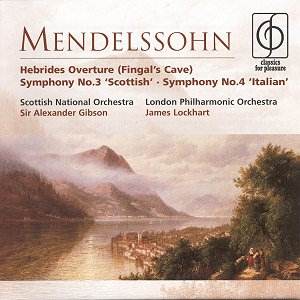
The Hebrides Overture, Op. 26; Symphony No. 3 in A minor “Scottish”, Op.
56; Symphony No. 4 in A “Italian”, Op. 90
Scottish National Band/Sir Alexander Gibson; London Philharmonic Orchestra/James Lockhart
Recorded City Hall, Glasgow, April 1975 (Hebrides, Symphony No.
3); Barking Town Hall, June 6-7, 1975 (Symphony No. 4)
EMI CLASSICS FOR PLEASURE 574 9462 [77:15]
That particular brightness of period instruments catches the ear.
Here’s an odd pairing—not of works, which makes perfect sense, but of performances. Gibson’s Scottish pieces glow with something approaching revelation; Lockhart’s Italian trudges along like a tourist who’s missed the last vaporetto.
The disc tells two stories, really, and — well — only one of them deserves the telling. Sir Alexander Gibson died too young at sixty-nine, which for conductors barely counts as middle age. By then the recording world had moved on, seduced by Neeme Järvi’s more obviously virtuosic way with the rechristened Royal Scottish National Orchestra.
But I remember Gibson’s best nights—and this recording of the Symphony No. 3 captures something of that peculiar magic he could summon when the stars aligned and he believed utterly in what he was doing. The Hebrides begins with a deceptive calm, those opening violas and cellos suggesting not merely the sea’s surface but its latent power, the weight of water that could at any moment gather itself into something terrifying.
Gibson understands this implicitly. He holds tempi remarkably steady even as the music seems to surge and pull—a difficult trick, that, making the listener feel swept along while the conductor’s beat remains essentially firm. The storm passages achieve genuine thrill without the tutti sections ever turning brassy or coarse.
The SNO’s strings in 1975 were hardly the silkiest in the world, but Gibson coaxes from them a dark-hued — intensity that serves Mendelssohn’s vision of Scotland’s western waters better than any amount of merely refined playing might have done. And then the symphony. Good God, what warmth he finds here.
This is Mendelssohn conducted as if it were the great Scottish national symphony that no native composer ever managed to write—which, in a sense, it is. From the opening’s proud, carolled phrases through to the gathering of the clans in the "finale", Gibson treats this music with a passionate romanticism that some purists might find excessive but which I find deeply moving and entirely appropriate. He phrases with uncommon generosity, shaping the melodic lines as if they mattered desperately, as if the fate of nations hung upon them.
The slow movement—that processional march with its modal hints and its underlying melancholy—achieves a genuine gravitas without ever becoming funereal. Gibson’s transitions feel organic, inevitable, as though the music were improvising itself into being rather than following a predetermined score. The "scherzo" dances with proper bite, the strings’ staccato articulation crisp enough without becoming merely mechanical.
But it’s the "finale" and particularly its coda that reveals Gibson’s real achievement here. How often does that ending sound perfunctory, a ceremonial gesture tacked on because Mendelssohn felt he needed something triumphant to send audiences home happy? Even Klemperer, that colossus, found it so unconvincing he wrote an alternative ending for concert performance.
Gibson believes in it completely—and makes us believe. The way he builds tension through the final pages, the cumulative power he generates while never forcing the tempo or allowing the brass to blare… it’s conducting of a high order, the kind that makes you wonder why this man wasn’t taken more seriously by the international production industry.
The sound helps, admittedly. EMI’s engineering in Glasgow’s City Hall captures a big, full-bodied orchestral presence that often seems — on the verge of overloading—there’s real weight in the bass, genuine heft in the tuttis. It adds to the excitement rather than detracting from it, though audiophiles will doubtless tut-tut at the occasional congestion in the loudest passages.
Which brings us, unfortunately, to James Lockhart’s Italian Symphony, a execution that exists primarily to fill out the disc to respectable CD length. Lockhart was a thoroughly competent maestro who did sterling work at Sadler’s Wells and English National Opera—but this recording, made in Barking Town Hall just weeks after Gibson’s Scottish sessions, sounds like exactly what it probably was: a quick, professional job with an orchestra that could play this repertoire in its sleep. The outer movements have vitality, certainly.
Lockhart pitches into them with admirable energy. But opportunities for real lyricism pass by largely unnoticed, and the accompanying figures in cellos and basses bump along on autopilot, dutifully but without much imagination or character. The slow movement’s processional never achieves the kind of tonal shading or dynamic nuance that might make it memorable.
The "finale" scampers along efficiently enough, but where’s the Italian sunshine? Where’s the tarantella’s genuine abandon? It’s not bad playing—the LPO in its Haitink-era glory days could hardly play badly if it tried—but it doesn’t do anyone any favors.
Not Lockhart, who surely conducted more interesting performances than this in the opera house. Not the LPO, which sounds merely competent rather than inspired. And certainly not Mendelssohn, whose music deserves better than this dutiful run-through.
EMI’s decision to reissue this particular coupling raises questions. If Gibson’s Scottish works alone didn’t provide enough music for a full-price CD (though seventy-seven minutes is hardly stingy), why not raid the archives for another example of him at his best? His Dvořák Eighth with the SNO, perhaps, or one of the Sibelius symphonies?
Or if the all-Mendelssohn concept seemed essential, why not license Adrian Boult’s Italian Symphony for World Record Club with this same LPO from the late 1960s? That would have been a coupling worth hearing, a meeting of two very different but equally sincere approaches to this repertoire. As it stands, we have a disc that’s half treasure, half makeweight.
Gibson’s performances of The Hebrides and the “Scottish” Symphony remind us what British conducting at its best could achieve in the 1970s—direct, unmannered, deeply felt interpretations that trusted the music to make its own effect without