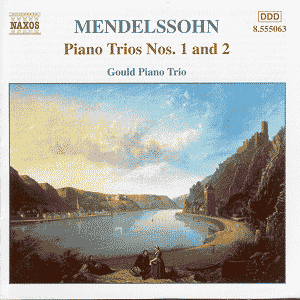
 Felix Mendelssohn: Piano Trios Nos. 1 in D minor, Op. 49, and 2 in C minor, Op.66 Gould Piano Trio (Lucy Gould, violin; Martin Storey, cello; Benjamin Frith, piano) Recorded Potton Hall, Dunwich, Suffolk, April 2000 NAXOS 8.555063; [57:02]
HONEGGER: Symphony No. 4, “Deliciae Basilienses”
MARTINŮ: Toccata e Due Canzoni
STRAVINSKY: Concerto in Ré
Kammerorchester Basel / Christopher Hogwood
Arte Nova 74321-86236-2 [65:43]
The idea is clever enough—reconstruct Paul Sacher’s January 1947 concert celebrating the twentieth anniversary of his Basler Kammerorchester, three world premieres commissioned from composers at the height of their powers. But historical recreation proves a treacherous business, and Christopher Hogwood’s attempt, while admirable in conception, stumbles in execution.
Sacher was no dilettante. His wife’s fortune (the pharmaceutical Hoffmann-La Roche millions) gave him the means, but his musicianship gave him the right to commission Bartók’s Divertimento, Strauss’s Metamorphosen—works that have entered the permanent repertoire. These three pieces from 1946 haven’t, and listening to this disc you understand why.
The sound Hogwood cultivates is thin, deliberately so—whether from conviction or necessity I can’t quite determine. Perhaps he’s trying to evoke the string tone of immediate postwar Swiss orchestras, which Honegger’s own recordings confirm were nothing to write home about. But period-instrument austerity applied to midcentury neoclassicism produces an oddly undernourished effect.
The Kammerorchester Basel (not Sacher’s original ensemble, which dissolved long ago) plays with workmanlike competence but little color, and—well—the intonation wavers at crucial moments. Martinů’s Toccata e Due Canzoni comes off best. Written during his American exile, it’s vintage Martinů—which is to say, you’ve heard this music before if you know the composer at all.
The familiar motorism, the sudden lyric expansions—the Czech folk inflections filtered through Parisian sophistication. Florian Hölscher attacks the piano part with welcome gusto, and Hogwood, a Martinů enthusiast, draws genuine buoyancy from his players. The infectious energy carries the day despite the lean orchestral sound.
Stravinsky’s Concerto in Ré receives a crisp, angular reading that captures the work’s balletic gestures. This is one of the composer’s less-performed neoclassical essays—unfairly so, since it contains some of his most austere string writing. The opening’s spare textures and the "finale"’s rhythmic drive come across well enough.
That particular brightness of period instruments catches the ear.
But the slow movement wants a sheen, a warmth that this interpretation never quite locates. When Stravinsky aims for nobility, as in the central “Arioso,” these strings sound merely correct. Then there’s Honegger’s Fourth.
The “Deliciae Basilienses” subtitle refers to Basel’s pleasures, and one assumes Honegger meant it affectionately—Sacher had, after all, commissioned the work. But this is a rambling, curiously lifeless piece that even an advocate like Hogwood can’t rescue. The composer made grandiloquent claims for his symphonies, positioning himself as heir to the great Germanic tradition.
Here that ambition collapses into episodic writing that never coheres. The slow movement’s wind solos expose the orchestra’s limitations brutally—pale, colorless playing of banal material. No interpretive insight can redeem music this earthbound.
The documentation is first-rate: original program notes by Martinů and Honegger (Stravinsky characteristically declined to contribute), full ensemble lists, and historical context. Arte Nova’s super-budget price makes this an attractive proposition for Martinů completists or Sacher enthusiasts. But two thoughts nag.
First, that historical reconstruction doesn’t guarantee musical interest—these works have remained obscure for good reason. Second, that Hogwood’s period-instrument sensibility, so revelatory in Mozart and Haydn, translates awkwardly to midcentury repertoire that wants more body, more sonic heft. Worth investigating for the Martinů, tolerable for the Stravinsky, a miss for the Honegger.
The Sacher legacy contains genuine treasures, but this particular anniversary concert wasn’t among them.